Amazon S3 Storage and Advanced Capabilities Now Available Natively on Vercel and v0 Marketplace

The landscape of modern web development underwent a significant shift today as Amazon Web Services (AWS) announced the native integration of Amazon Simple Storage Service (Amazon S3)—including specialized features such as Amazon S3 Tables and Amazon S3 Vectors—directly into the Vercel Marketplace and v0 by Vercel. This development bridges one of the cloud industry’s most ubiquitous object-storage infrastructures with one of the developer ecosystem’s fastest-growing frontend and deployment platforms. By streamlining provisioning and authentication workflows, the integration aims to eliminate friction for millions of developers who build, deploy, and scale data-intensive web and artificial intelligence applications.
Background Context and Evolution of the Integration
For years, developers working with high-performance web frameworks like Next.js on Vercel faced a fragmented operational experience when needing scalable cloud storage. While Vercel provided seamless deployment pipelines and edge computing capabilities, provisioning underlying storage infrastructure typically required context-switching away from the platform. Developers had to log into the AWS Management Console, manually configure security policies, generate static access keys, and handle environment variable wiring across distributed environments.
This friction ran counter to the broader industry movement toward serverless architectures and unified developer experiences. Recognizing this gap, AWS and Vercel previously established integration pathways for other foundational AWS services, including Amazon Aurora, Amazon DynamoDB, and Amazon OpenSearch Serverless. The addition of Amazon S3 represents the culmination of this strategy, completing a full-stack offering that bridges database, object, table, and vector storage layers within a single, unified management workflow inside Vercel.
Core Technical Features: Covering Three Distinct Workloads
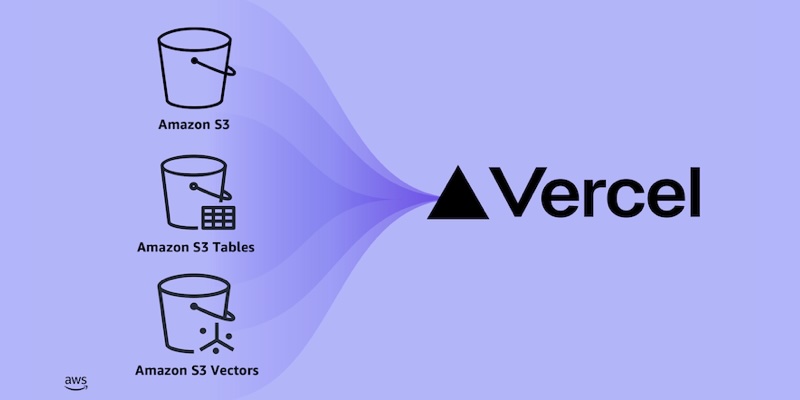
The newly launched integration is architected to address three primary pillars of modern application development: everyday object storage, high-performance analytics, and semantic artificial intelligence workflows.
For general-purpose application storage—such as user-uploaded media, static assets, and document repositories—developers can provision standard S3 buckets directly from the Vercel dashboard. The integration leverages OpenID Connect (OIDC) authentication, utilizing @vercel/functions/oidc to exchange short-lived tokens with the AWS Security Token Service (AWS STS) at runtime. This eliminates the security risks associated with storing static, long-lived AWS credentials in environment variables.
In the realm of analytics, the integration incorporates Amazon S3 Tables. Purpose-built for data lakes and analytics engines, S3 Tables provide fully managed Apache Iceberg tables featuring automated maintenance and compaction. Developers can leverage lightweight query engines, such as DuckDB running directly inside Vercel Functions, to execute complex aggregations and analytical queries over massive datasets without managing external cluster infrastructure.
For AI-driven applications, the introduction of Amazon S3 Vectors provides cost-optimized vector storage natively integrated into S3. Designed to support Retrieval-Augmented Generation (RAG) pipelines, semantic search, and AI agent workloads, S3 Vectors allow development teams to store and query high-dimensional embeddings alongside their primary data assets, removing the strict necessity of maintaining a separate, dedicated vector database infrastructure.

Chronology and Step-by-Step Implementation Workflow
The deployment and connection workflow has been designed to reduce configuration time to mere seconds. Beginning today, teams operating within the Vercel ecosystem can execute the following structured chronology to provision and integrate S3 resources:
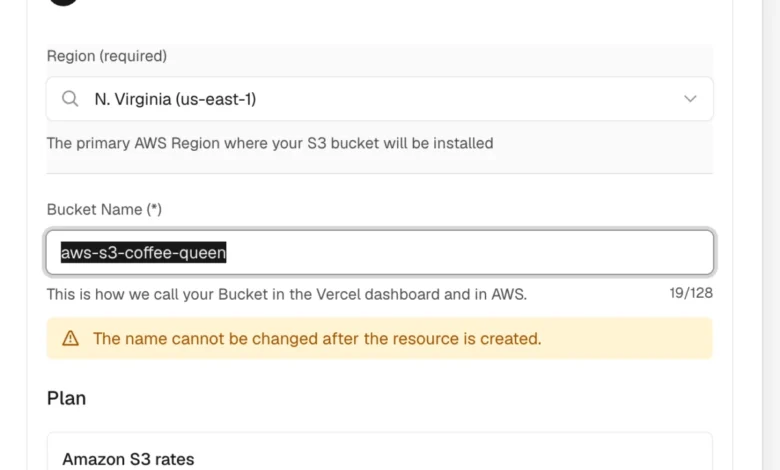
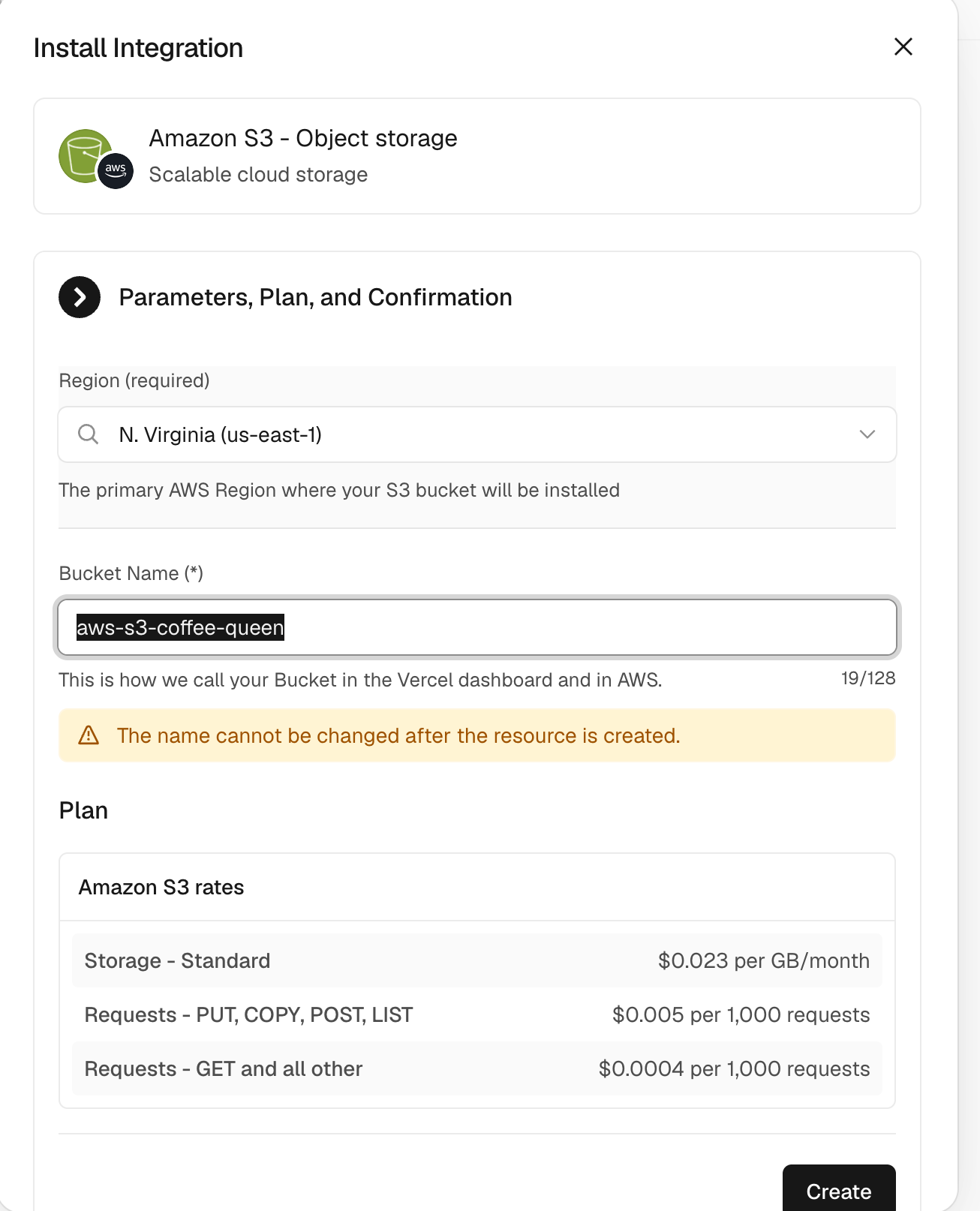
- Resource Provisioning: From the Vercel dashboard, administrators navigate to the Storage tab, select the Create option, designate AWS as the provider, choose the appropriate S3 bucket variant (General Purpose, Tables, or Vectors), and select a target AWS Region.
- Project Linking and Environment Injection: Once the bucket is generated, developers link the resource to their local or cloud-based project. Using the Vercel Command Line Interface (CLI) via commands such as
vercel linkandvercel env pull .env.local, the platform automatically injects necessary runtime variables—includingAWS_REGION,AWS_ROLE_ARN,AWS_RESOURCE_ARN, and resource-specific bucket identifiers. - Runtime Execution: Applications interact with the provisioned resources securely. For instance, Next.js API routes utilize standard AWS SDK clients (@aws-sdk/client-s3 or @aws-sdk/client-s3vectors) combined with Vercel’s OIDC credential provider to execute object uploads, database attachments, or vector similarity searches dynamically.
Furthermore, integration with v0 by Vercel allows non-linear, natural-language provisioning. By describing an application concept—such as requesting "a photo gallery where users upload images using AWS," "a support bot that answers questions from my PDFs," or "an analytics dashboard for my clickstream data"—v0 automatically provisions the correct S3 resource type, configures the underlying architecture, and generates functional source code.
Account Management, Billing, and Pricing Architecture
The collaboration accommodates both greenfield development and established enterprise setups. Engineering teams may opt to create a brand-new AWS account directly through the Vercel integration workflow, which includes a promotional offering of $100 in AWS credits valid for six months. Alternatively, organizations can link pre-existing AWS accounts, preserving their current enterprise discount structures, compliance frameworks, and centralized billing arrangements.
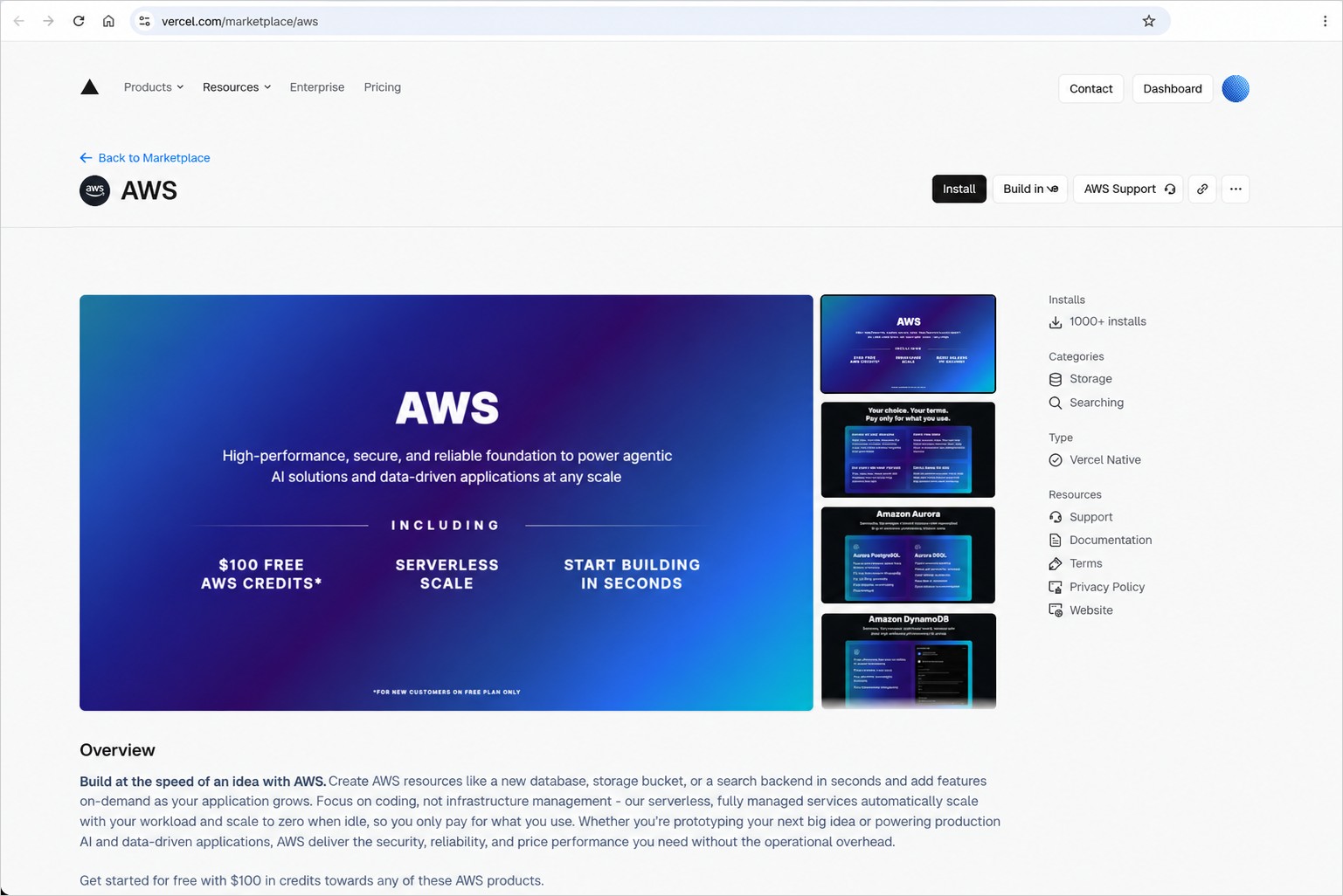
Crucially, all provisioned S3 resources reside directly within the user’s designated AWS account, ensuring that organizations retain full ownership of their data alongside native access to AWS security tooling, governance policies, and auditing utilities. The integration layer itself incurs no additional software fee from Vercel; developers pay only standard, consumption-based Amazon S3 pricing for the storage, retrieval, and compute resources consumed.
Industry Implications and Broader Analysis
From an architectural standpoint, this integration underscores the blurring lines between frontend application platforms and hyperscale cloud infrastructure providers. As modern web development becomes increasingly reliant on distributed microservices, edge computing, and real-time AI inference, the administrative overhead of managing cross-cloud credentials has emerged as a primary bottleneck for engineering velocity.
By abstracting the provisioning layer while maintaining underlying infrastructure ownership, AWS and Vercel are setting a new benchmark for developer ergonomics. Analysts note that this reduction in operational friction could significantly accelerate the adoption of advanced cloud-native paradigms—particularly Apache Iceberg data architectures and vector-based semantic search—among small-to-medium development teams that previously lacked the specialized engineering bandwidth required to configure such systems manually.
Availability and Support
Amazon S3, S3 Tables, and S3 Vectors are available globally across all commercial AWS Regions supported by Vercel. Development teams can begin building immediately via the Vercel Marketplace or the v0 application interface. For technical troubleshooting, API documentation, and regional service availability checks, developers are encouraged to utilize the official AWS Model Context Protocol (MCP) Server or participate in community discussions hosted on AWS re:Post for Amazon S3.
Related posts: