Attackers Exploit Issabel Framework Flaw Enabling Unauthenticated OS Command Execution

Understanding the Mechanics of CVE-2026-89026
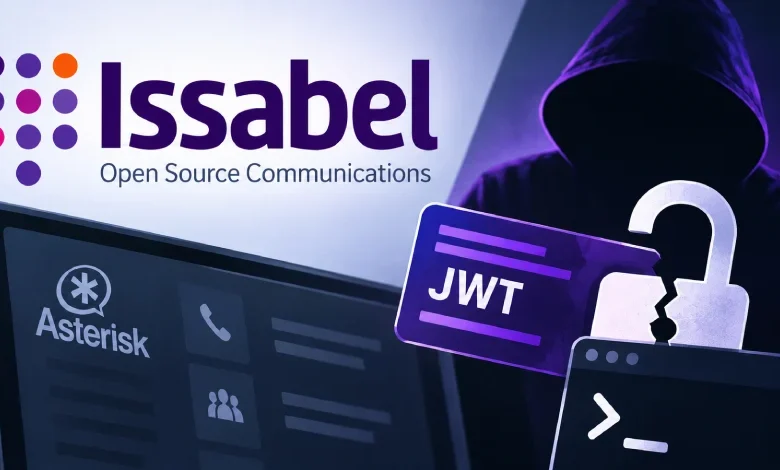
At the heart of this security failure is the implementation of hard-coded credentials within the software’s architecture. Specifically, the Issabel Framework utilized a static HS256 JSON Web Token (JWT) signing key located within the pbxapi index.php file. Because this cryptographic key was identical across every installation of the framework, it rendered the authentication mechanism effectively useless against any attacker aware of the key.
By leveraging this hard-coded key, an unauthenticated actor can forge valid bearer tokens. These tokens are then used to interact with the /pbxapi/manager/originate endpoint. This specific endpoint is designed to interact with the Asterisk engine—the core of the Issabel PBX system—to facilitate call origination. By injecting a malicious System application parameter, the attacker can force the Asterisk service to execute arbitrary commands at the operating system level. Because the Asterisk service typically runs with elevated privileges, the attacker gains a high degree of control over the host machine, potentially leading to full system takeover, data exfiltration, or the deployment of secondary malware, such as ransomware or botnet agents.
Chronology of Discovery and Exploitation
The timeline of the vulnerability’s lifecycle reveals a concerning gap between the development of a fix and the onset of malicious activity.
- August 1, 2026: The Issabel Foundation released a security patch addressing the hard-coded JWT key. The remediation involved removing the static string "da893kasdfam43k29akdkfaFFlsdfhj23rasdf" from the source code and transitioning to a dynamic key storage method, utilizing the
/etc/issabel.confconfiguration file to ensure unique, secure keys per installation. - September 9, 2026: The Shadowserver Foundation, a prominent non-profit organization dedicated to internet security, reported the first observable instances of the vulnerability being exploited in the wild.
- September 16, 2026: Security firm VulnCheck issued a formal advisory confirming the nature of the exploit and providing technical details on how attackers were abusing the
pbxapimanager endpoint.
The period between the patch release and the first detected attacks suggests a window of approximately five weeks. This interval highlights a common challenge in cybersecurity: the "patch gap," where software vendors release security updates, but the end-user community fails to deploy them in a timely manner, leaving systems exposed to automated scanning and exploitation.
The Broader Context of PBX Security
The exploitation of Issabel Framework highlights a persistent trend in the security of Unified Communications (UC) systems. PBX platforms, which serve as the central nervous system for corporate telephony and messaging, are high-value targets. An attacker who gains control over a PBX system can perform a variety of malicious actions, including:
- Toll Fraud: Hijacking the PBX to place high-cost international calls, resulting in significant financial losses for the organization.
- Eavesdropping: Intercepting internal communications, recording sensitive calls, and gaining access to private enterprise data.
- Lateral Movement: Using the compromised server as a beachhead to scan and attack other internal network assets that would otherwise be shielded by a firewall.
- Service Disruption: Shutting down communication lines, which can cripple business operations, particularly for organizations reliant on 24/7 call centers or customer support lines.
The use of hard-coded credentials—often referred to as "backdoor-by-design" or poor development practice—has historically been a significant vulnerability in embedded systems and network appliances. While modern secure development lifecycles (SDLC) generally forbid the inclusion of static secrets in source code, legacy codebases and rapid development environments often fall victim to these oversights.
Analysis of Threat Implications
The technical nature of this exploit makes it particularly dangerous because it does not require prior knowledge of user accounts or administrative passwords. An attacker only needs network-level access to the Issabel web interface. In many enterprise environments, these interfaces are inadvertently exposed to the public internet, making them trivial to find via search engines like Shodan or Censys.

The CVSS score of 9.8 reflects the "Critical" severity, defined by the low complexity of the attack, the lack of necessary privileges, and the high impact on confidentiality, integrity, and availability. Security analysts emphasize that the ease of automation—where an attacker can write a simple script to scan thousands of IP addresses for the presence of the vulnerable endpoint—significantly amplifies the danger.
Furthermore, because the exploit occurs through the Asterisk manager interface, the commands are executed by the asterisk user. While this is not always the root user, in many default configurations, the permissions assigned to the asterisk user are sufficient to allow for privilege escalation, persistent backdoor installation, and the modification of system configurations.
Response and Mitigation Strategies
In response to the growing threat, cybersecurity professionals and the Issabel Foundation have provided clear directives for administrators. The primary defense is the immediate application of the patch provided on August 1, 2026. However, for organizations that cannot update immediately, several "defense-in-depth" measures are recommended:
- Network Segmentation: Ensure that the PBX management interface is not accessible from the public internet. Access should be restricted to trusted IP ranges or managed via a secure VPN.
- Access Control Lists (ACLs): Implement strict firewall rules that block unauthorized access to the
/pbxapi/directory. - Monitoring and Logging: Enable enhanced logging for the Asterisk manager interface to detect anomalous calls to the
originatefunction. Unusual activity, such as unexpected system-level command execution, should trigger an immediate security alert. - Credential Rotation: Following the patch, administrators must ensure that the
/etc/issabel.conffile contains a unique, complex, and high-entropy key to replace the previously exposed static secret.
The Path Forward for Open-Source Security
The incident involving CVE-2026-89026 serves as a stark reminder of the complexities inherent in maintaining open-source security. While the Issabel Foundation was quick to provide a patch, the responsibility for securing the ecosystem is shared between the maintainers and the deployers.
The security community has increasingly advocated for "security-by-default" configurations. For developers, this means ensuring that applications are shipped with no pre-configured passwords or keys, requiring the end-user to generate unique security tokens upon the first installation. Furthermore, the use of automated static analysis tools (SAST) during the build process could have identified the hard-coded key long before it was introduced into a production environment.
As the industry moves forward, organizations utilizing unified communications frameworks must treat these systems with the same level of security rigor as they do their core database or financial servers. The convergence of voice and data networks means that a vulnerability in a phone system is now effectively a vulnerability in the broader corporate network.
Security researchers at VulnCheck and other organizations continue to monitor the situation. While there are currently no verified reports identifying a specific advanced persistent threat (APT) group behind the attacks, the use of such a critical vulnerability typically attracts opportunistic actors looking to monetize access through ransomware-as-a-service or by selling access to compromised networks on the dark web. Administrators are strongly urged to verify their installation’s status, review logs for suspicious activity dating back to at least early September, and prioritize the implementation of the vendor’s provided security updates.
Related posts: