The Illusion of Engagement: Why Marketing Leaders Must Pivot From Volume to Trust in the Age of Generative AI


Modern marketing operations face an unprecedented paradox: while leaders are armed with more content creation tools, targeted impressions, and rich engagement data than at any point in history, earning genuine audience attention has become remarkably elusive. This friction point formed the central thesis of a heavily attended panel session at the September MarTech Conference. Titled “The engagement illusion: What actually gets attention and what gets ignored,” the session convened top industry veterans to dissect why traditional volume-based strategies are failing and how modern brands can recalibrate their approach to audience acquisition and retention.
The panel was moderated by Jessica Hawthorne-Castro, CEO of Hawthorne Advertising, who guided a robust discussion alongside a trio of distinguished industry leaders: Shiv Gupta, chief solutions and analytics officer at The Loop Group; John Miller, president of Scribewise; and Julie Swisser, global CMO at Office Beacon. Together, these executives mapped out the structural shifts occurring across the digital landscape, delivering a sobering consensus for marketing strategists: sheer publishing volume can no longer serve as a substitute for authentic value.
The Genesis of the Attention Crisis
To understand how the marketing ecosystem reached this juncture, industry analysts look back at the rapid democratization and deployment of generative artificial intelligence over the past several years. Initially adopted as a productivity enhancer, generative AI tools quickly flooded every digital channel with automated content. Blogs, email campaigns, social media feeds, and programmatic ads multiplied exponentially, creating a hyper-saturated digital marketplace.

This content explosion fundamentally altered buyer behavior. Audiences, inundated by formulaic messaging and algorithm-driven campaigns, developed a sophisticated tolerance for standard marketing plays, tuning out generic content with increasing precision. Furthermore, the volatility of search and social algorithms made organic visibility a perpetually moving target. Marketing departments that once relied on high-frequency publishing schedules suddenly found their metrics inflated by artificial impressions that failed to translate into pipeline momentum.
Compounding this challenge is a structural evolution in how prospective business-to-business (B2B) and business-to-consumer (B2C) buyers validate potential vendors. Rather than relying on traditional top-of-funnel touchpoints or immediately engaging with sales representatives, modern buyers increasingly bypass early-stage gatekeepers altogether. Instead, prospective customers leverage advanced large language models—such as ChatGPT, Claude, and Gemini—to independently research vendor track records, parse authentic customer reviews, and synthesize third-party media coverage. Consequently, maintaining absolute brand consistency and verifiable authority across every digital touchpoint has transitioned from a best practice into an absolute operational requirement.
Redefining Credibility: Expertise as Currency
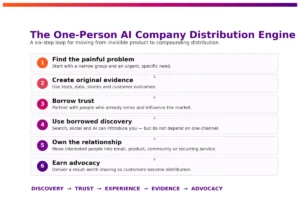
During the conference panel, the speakers emphasized that attention has effectively transformed into a high-value currency. Just as institutional investors demand rigorous due diligence before allocating capital, modern buyers demand rigorous signals of trust and deep expertise before committing their time or budget.
Panelist Shiv Gupta of The Loop Group noted that claiming authority via sleek slide decks or polished landing pages is no longer sufficient to sway discerning buyers. Instead, organizations must substantiate their claims by demonstrating deep, actionable expertise distributed across both owned digital channels and trusted third-party platforms. These signals of credibility must be immediate, transparent, and seamlessly consistent across every customer interaction. If a brand fails to prove its competence early in the buyer journey, prospects swiftly migrate to competitors who can.

This sentiment was reinforced by John Miller of Scribewise, who challenged the traditional enterprise fixation on output volume. Tracking marketing success strictly by the volume of assets produced—such as whitepapers published, emails sent, or ad impressions bought—measures internal effort rather than external impact. Miller offered a vivid analogy to illustrate the flaw in this metric: judges do not evaluate the quality of a haircut by measuring how much hair falls onto the floor, but rather by assessing the final aesthetic result. Similarly, digital visibility devoid of underlying trust generates nothing more than expensive noise.
The Pitfalls of Frequency and Superficial Metrics
A recurring theme throughout the MarTech Conference session was the dangerous misinterpretation of frequency as relationship-building. Many marketing operations teams mistakenly equate repeated brand touchpoints with customer engagement. Increasing email cadences, programmatic ad delivery frequencies, or social posting volumes does not create inherent value for the buyer.
Instead of organizing content calendars around internal reporting milestones and quarterly quotas, marketing leaders are urged to reevaluate their strategy through the customer’s lens. The fundamental diagnostic question for any marketing interaction must be whether it provides the consumer with a compelling, rational reason to choose the brand over alternatives.
Compounding this misstep is the continued reliance on legacy performance indicators. Familiar metrics such as raw click-through rates, page views, and basic form fills still provide necessary operational context, but relying on them as isolated indicators of strategic success is deeply flawed. Modern buyers navigate highly fragmented, non-linear paths that span social networks, peer review aggregators, independent media outlets, and AI-driven answer engines. The cumulative, qualitative impression left across this broader digital ecosystem carries exponentially more weight than a single click on a paid banner ad.

To capture a more accurate picture of performance, strategic teams are increasingly shifting toward qualitative engagement metrics, evaluating depth of interaction, brand sentiment, and community participation rather than superficial reach.
Organizational Alignment and the Future of Trust
Addressing the engagement illusion requires a fundamental dismantling of internal silos. Panelist Julie Swisser of Office Beacon stressed that marketing departments can no longer build and maintain trust in a vacuum. Because modern buyers experience enterprises as a unified single entity, a single friction point in customer support, billing, or sales interactions can instantly neutralize months of meticulously executed marketing campaigns.
Establishing enduring brand trust is a shared organizational mandate. Marketing, sales, customer success, and operations teams must align their key performance indicators around the holistic customer experience, ensuring that every department acts as an active custodian of buyer confidence.
As automated and artificially generated content continues to proliferate across the digital economy, authentic human expertise and genuine relationship-building are poised to appreciate in value. While trust, community advocacy, and deep domain authority may not always fit neatly into a standard quarterly dashboard KPI, they represent the ultimate competitive advantage for modern organizations.

The overarching takeaway from the September MarTech Conference is that overcoming the engagement illusion is entirely achievable, provided marketing leaders are willing to abandon the pursuit of empty volume. By prioritizing verifiable expertise, aligning cross-functional operations, and focusing ruthlessly on customer trust, brands can cut through the digital noise and build resilient, long-lasting market relevance.