What Is So Good About ChatGPT Work: A Comprehensive Analysis of the 2026 Frontier AI Landscape

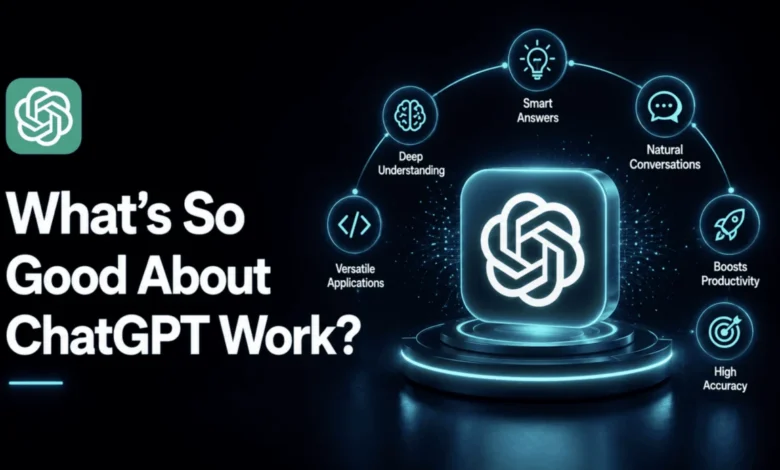
The global artificial intelligence sector experienced an unprecedented convergence of flagship model releases during a compressed eight-week window in the summer of 2026. This intense period of competition saw Anthropic release Claude Sonnet 5 on June 30, xAI deploy Grok 4.5 on July 8, OpenAI make GPT-5.6 generally available on July 9, and Google continuously iterate on Gemini 3.1 Pro. With multiple premier laboratories launching capable systems within days of one another, industry analysts noted a distinct shift in how enterprise buyers evaluate artificial intelligence. The traditional fixation on benchmark supremacy—asking simply which model is the smartest—has become obsolete, as performance advantages fluctuate weekly and narrow performance gaps rarely impact real-world productivity. Instead, the critical metric for enterprise adoption has become practical utility: how effectively a product translates raw intelligence into completed workflows, automated reports, and functional applications. Within this shifting paradigm, OpenAI’s ChatGPT Work, powered by the GPT-5.6 architecture, has emerged as a focal point for organizations seeking operational efficiency rather than mere conversational prowess.
Background Context and the Summer 2026 Model Convergence
The simultaneous rollout of major frontier models in mid-2026 represents the maturation of the generative AI industry. For years, the market was characterized by staggered releases where a single laboratory would hold a monopoly on state-of-the-art capabilities for six to twelve months. By the summer of 2026, however, the technical parity among leading AI research facilities shortened development cycles significantly.
Anthropic, Google, OpenAI, and xAI now operate on overlapping release schedules driven by aggressive commercial demands and rapid hardware scaling. This hyper-competitive environment has forced labs to differentiate their offerings not solely through raw parameter counts or benchmark scores, but through architectural packaging, inference economics, and integration ecosystems. OpenAI’s strategic response to this competitive pressure was the development of ChatGPT Work, an enterprise-grade platform designed to ingest complex multi-step objectives and synthesize them into finished artifacts—ranging from formatted spreadsheets and interactive dashboards to comprehensive research reports—by drawing context directly from a company’s native file repositories and software tools.
Architecture and Tiered Model Economics of GPT-5.6
A defining characteristic of the GPT-5.6 model family, which anchors ChatGPT Work, is its departure from the prevailing industry trend of utilizing a single flagship model equipped with a reasoning-effort slider. Instead, OpenAI segmented the GPT-5.6 architecture into three distinct, commercially viable tiers: Luna, Terra, and Sol.
This tiered strategy allows enterprise teams to optimize cost and performance dynamically without switching platforms. Routine, high-volume tasks that require low latency can be routed to the lightweight Luna tier, minimizing compute expenditure. Meanwhile, complex computational or logical tasks can be escalated to the Sol tier or its higher-compute variants without incurring the prohibitive costs associated with running a maximum-capacity model for every routine interaction.
Industry benchmarks evaluating this architecture present a nuanced picture of technical capability. On Terminal-Bench 2.1, a rigorous agentic coding benchmark, the Sol tier achieved an 88.8% score in standard mode and reached 91.9% in its high-compute Ultra mode, narrowly surpassing both GPT-5.5 and Anthropic’s Claude Mythos 5, which registered 88.0%. However, competitive offerings maintain specific advantages in other domains. Anthropic’s Claude Fable 5—the premium tier of the Mythos family—outperformed Sol on SWE-Bench Pro, scoring 80% compared to Sol’s 64.6%, and secured a higher placement on the Artificial Analysis Intelligence Index.
Despite trailing in select specialized benchmarks, GPT-5.6 excels in the economic trade-offs that dictate enterprise procurement decisions. Fable 5 commercializes at $10 per million input tokens and $50 per million output tokens—double the rate of the Sol tier. OpenAI’s internal and independent evaluations indicate that Sol achieves comparable or superior outcomes on numerous agentic and software engineering tasks while consuming significantly fewer tokens and requiring less processing time. For corporate buyers managing high query volumes, this efficiency translates into a compelling value proposition: near-frontier performance coupled with substantially reduced operational costs and faster response times.
Open-Weight Offerings and Infrastructure Sovereignty
In addition to its proprietary cloud-hosted models, OpenAI diversified its market approach by releasing open-weight models designed for self-hosted enterprise infrastructure. The introduction of gpt-oss-120b and gpt-oss-20b under the permissive Apache 2.0 license marked OpenAI’s first open-weight release since its early developmental era.
Engineered specifically for organizations with strict data residency mandates, these models enable complete customization through proprietary fine-tuning pipelines. They are compatible with standard inference stacks such as vLLM, Ollama, and llama.cpp, allowing enterprises to deploy advanced language model capabilities entirely on private servers without transmitting data through external APIs. While these open-weight iterations operate independently of the consumer ChatGPT interface and OpenAI’s managed cloud services, their availability provides institutional buyers with an alternative to the binary choice of total cloud reliance or complete technological exclusion.
Practical Applications and Enterprise Case Studies
The operational value of ChatGPT Work manifests most clearly in its interface capabilities, which are engineered to reduce manual data handling. Rather than requiring users to manually extract, format, and input data from disparate enterprise systems, the platform utilizes advanced agentic execution to coordinate tasks across connected corporate environments.
Documented deployments across major technology firms illustrate the tangible impact of these workflows:
- At Zapier, an automated lead-triage framework was developed to replace a manual process that previously required 35 to 45 minutes per lead across HubSpot, Gong, and email systems. The automated system tracks customer journeys and identifies conversion drop-offs, a capability that enterprise marketing leadership reports has surfaced seven figures in active sales pipeline value monthly.
- At NVIDIA, Go-to-Market managers utilized automated workflows to eliminate manual data aggregation tasks that historically consumed approximately 40% of their working hours prior to major events such as the GPU Technology Conference (GTC). Routine number-crunching and report generation now execute bi-weekly, reallocating human capital toward strategic engagement with field sales teams.
- At Shopify, applied AI teams integrated the platform into daily operations as a continuous contextual layer. The system synthesizes communications from team messaging channels into a unified operational repository, coordinating complex research initiatives across thousands of non-technical employees.
These enterprise implementations highlight a broader industry transition from conversational experimentation to deeply embedded workflow automation, where AI systems function as persistent digital colleagues rather than isolated query-and-response interfaces.
Scheduled Tasks and Operational Automation
Underpinning much of this automation is the Scheduled Tasks feature set, which underwent a major architectural overhaul in mid-2026 with the introduction of a dedicated scheduling management interface. This functionality enables users to transform ephemeral conversational prompts into autonomous, recurring routines—such as automated executive briefings, status report generation, and continuous market monitoring that triggers alerts only when specified parameters change.
Integrated with live web browsing and enterprise application connectors like Gmail and Slack, scheduled tasks bridge the gap between static calendar alerts and active administrative agents. System constraints dictate that tasks cannot execute at frequencies higher than once per hour, and active task limits scale with subscription tiers: three for Go, five for Plus, and up to fifteen for Pro, Business, and Enterprise accounts. These transparent boundaries provide predictable operational capacity for engineering teams designing automated workflows.
Interoperability and the Model Context Protocol (MCP)
A critical factor in the adoption of enterprise AI tools is their ability to interface securely with existing software stacks. Rather than enforcing a proprietary integration ecosystem, OpenAI adopted the Model Context Protocol (MCP)—an open standard originally developed by Anthropic and subsequently transitioned to a vendor-neutral governance foundation in late 2025.
Because MCP functions as an open standard, a single internal integration built by an enterprise development team can serve multiple AI platforms, including ChatGPT and Claude, preventing vendor lock-in. Within ChatGPT, this protocol is implemented via Developer Mode for remote MCP servers on individual paid tiers, and as workspace-published MCP apps for Business, Enterprise, and Education accounts, featuring full support for read and write actions.
The ecosystem response to OpenAI’s Apps SDK has been rapid. Within sixty days of release, over thirty-five enterprise software vendors launched native ChatGPT applications or MCP integrations, including major platforms such as Salesforce, Box, Dropbox, Atlassian, and Adobe. Combined with a library of over 1,400 built-in plugins, these integrations have largely resolved the technical friction of connecting conversational AI models to foundational business software.
Data Access, Free-Tier Limitations, and Usage Guardrails
To maintain relevance in dynamic operational environments, AI models must integrate real-time data retrieval alongside static training parameters. ChatGPT incorporates live web browsing capabilities to synthesize current internet data mid-session, while Agent Mode extends this functionality into sequential multi-step execution—enabling the system to browse, execute code, and query connected databases within a single unified session.
Access models and pricing tiers define distinct operational boundaries for users. The free tier provides limited access to default models—approximately 10 messages every 5 hours—before automatically transitioning to a lighter fallback model until the usage window resets. The Plus subscription, priced at $20 per month, expands capacity to approximately 160 messages every 3 hours on standard models, alongside a dedicated weekly allowance for advanced reasoning models. Higher-tier Pro, Business, and Enterprise plans offer expanded capacity designed for heavy professional usage, though all tiers remain subject to fair-use guardrails to ensure platform stability.
Comparative Market Overview
| Metric | GPT-5.6 (ChatGPT Work) | Claude Sonnet 5 | Gemini 3.1 Pro | Grok 4.5 |
|---|---|---|---|---|
| Release Date | July 9, 2026 | June 30, 2026 | Rolling updates (2026) | July 8, 2026 |
| Pricing (Per Million Tokens) | Sol: $5/$30 Terra: $2.50/$15 Luna: $1/$6 |
$2/$10 (introductory through Aug 31, 2026), then $3/$15 | Variable by deployment path | $2/$6 |
| Context Window | 1.05 Million tokens | 1 Million tokens | 1 Million input / 65K output | 500K tokens |
| Standout Strength | Agentic execution, tiered cost/speed scaling, broad MCP ecosystem | High-performance in-repo coding at introductory pricing | Long-context multimodal workflows | Cost-efficient code generation, Cursor IDE integration |
Broader Industry Implications and Outlook
The maturation of frontier models in mid-2026 demonstrates that the artificial intelligence market has entered a phase of consolidation and pragmatic evaluation. While academic benchmarks will continue to serve as indicators of algorithmic advancement, the commercial success of platforms like ChatGPT Work indicates that enterprise adoption is increasingly determined by cost efficiency, integration standards, and the ability to execute complex, multi-step workflows with minimal human intervention. As open standards like the Model Context Protocol mature and infrastructure options expand to include both managed cloud services and self-hosted open-weight models, organizations possess unprecedented flexibility in deploying artificial intelligence across their operational architectures.