The migration from JavaScript-driven interface logic to modern CSS features such as Container Queries, the :has() selector, and native CSS nesting has become a hallmark of contemporary front-end development. While removing bloated JavaScript bundles in favor of native browser capabilities often results in cleaner code repositories and smaller file sizes, these architectural shifts can introduce hidden complexities within the wider application. When developers replace legacy logic with powerful CSS primitives, they often inadvertently alter the rendering environment in ways that the initial pull request diff fails to capture.
The core of the issue lies in the misconception that code simplicity is synonymous with system simplicity. A reduction in the number of lines of code is a measurable metric of local simplicity, yet the interaction between these new CSS rules and existing legacy systems—such as the CSS Cascade, block formatting contexts, and browser rendering engines—can create "accidental complexity." This phenomenon occurs when developers treat a new CSS feature as an isolated island, failing to account for how it integrates with the shared resources of the DOM and the browser’s layout engine.
A historical look at the evolution of front-end development reveals a recurring pattern: the drive to reduce JavaScript reliance often outpaces the development of tooling to debug the resulting CSS side effects. Between 2023 and 2026, the introduction of widespread support for :has() and container queries fundamentally changed how developers approach component state. However, as noted by industry analysts and contributors to platforms like GitHub and Reddit, these features have led to a surge in "ghost bugs"—spacing issues, layout collapses, and unexpected specificity conflicts—that are significantly harder to trace than the JavaScript errors they replaced.
Local Simplicity Versus System Complexity
In the current development ecosystem, a new CSS feature acts similarly to a new tenant in a shared apartment. While the tenant may be quiet and efficient, their presence necessitates a reconfiguration of how the other inhabitants interact. When a developer implements a container query to replace a ResizeObserver, they are not just deleting a script; they are inviting the browser’s container-type engine to manage layout containment. This change can trigger a ripple effect throughout the component hierarchy.
If the "tenant" (the CSS feature) is not properly introduced to the "housemates" (existing CSS rules, JavaScript event listeners, and layout constraints), the stability of the application is compromised. A common scenario involves the dual-ownership of layout logic. If a legacy ResizeObserver remains active in one file while a new @container rule is added in another, both pieces of logic may conflict once the screen width crosses specific breakpoints. Because the developer only updated the CSS, the JavaScript remains an invisible ghost in the machine, causing layout shifts that appear phantom-like to those only looking at the CSS files.
The Hidden Cost of Container Types and Layout Containment

The technical implications of declaring container-type: inline-size are often underestimated. When a developer applies this property, the browser does more than enable query support; it establishes a new block formatting context (BFC) and applies size containment. This carries significant consequences for the surrounding elements. For instance, margins that previously collapsed through the component will now be trapped inside it, potentially altering the vertical rhythm of the entire page.
Furthermore, elements that rely on their content to determine their width will collapse to zero if they are assigned size containment without an explicit width. This has led to numerous reports of "vanishing" interface components in production environments. Analysis of recent web development trends indicates that these bugs are not the result of faulty CSS syntax, but rather a lack of awareness regarding how these newer properties interact with legacy box-model behaviors. The browser is performing exactly as specified, but the developer’s mental model of the rendering engine is often based on pre-container-query norms.
The Cascade and the Specificity Trap
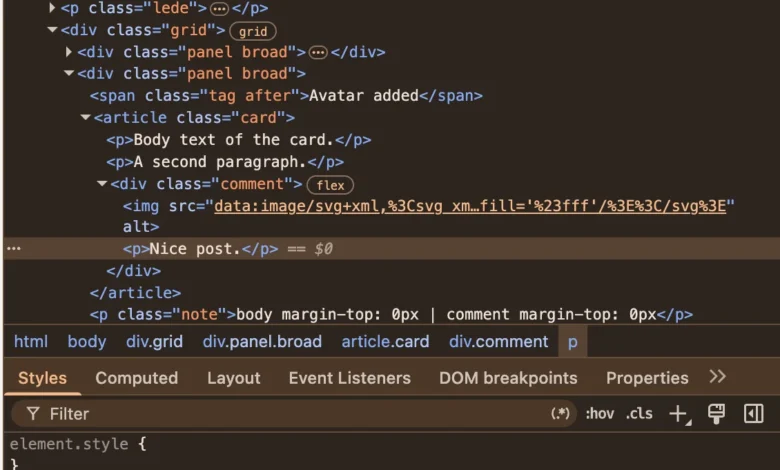
The introduction of the :has() selector and native CSS nesting has similarly reshaped the landscape of specificity. Because :has() allows developers to style parent elements based on their children, a seemingly innocuous rule can inadvertently reach far beyond the intended component. If a developer targets .card:has(img) p margin: 0; , every paragraph within that card—including those inside nested comments or secondary components—will be stripped of its margin.
In a complex, large-scale application, this creates a "specificity war." When nested selectors are used without proper scoping, they can inadvertently inherit the weight of the highest selector in their hierarchy, making them difficult to override. The standard solution—using :where() to zero out specificity—is an essential tool, yet it remains underutilized in many migrations. Data from professional front-end teams suggests that a significant percentage of production styling bugs stem from these unintended specificity leaks, where a new, "simpler" CSS rule overrides long-standing legacy styles because of its position in the cascade or its unexpected weight.
Performance Implications and Browser Rendering
Perhaps the most contentious issue is the performance impact of modern CSS. There is a prevailing belief that "CSS is faster than JavaScript," but this is a generalization that ignores the realities of the browser rendering engine. While CSS-based logic offloads work from the main thread, it can significantly increase the workload of the style and layout recalculation phases.
Testing conducted in late 2026 demonstrates that complex :has() selectors can cause the browser to restyle thousands of elements upon a single state change. In one test case, a seemingly minor rule anchored to the document body resulted in the restyling of 5,000+ elements whenever a single row was toggled. When multiple such rules exist in a large stylesheet, the cumulative performance cost can rival or exceed that of a well-optimized JavaScript implementation. Neither the CSS nor the browser’s dev tools provide an immediate warning that this is occurring, leading to performance degradation that is only discovered during end-user usage under high load.

Official Guidance and Industry Responses
Industry experts, including members of the CSS Working Group and contributors to web standards, have repeatedly emphasized that modern CSS features are not magic bullets. The consensus among senior engineers is that developers must treat CSS migrations with the same rigor as backend API refactors. This includes conducting performance traces, auditing the cascade, and ensuring that no legacy code is left "dangling" after a migration.
The "greenfield" bias in documentation and tutorials is a major contributor to these issues. Most articles demonstrate how a feature works in isolation, providing a false sense of security. In reality, modern enterprise applications are "brownfield" environments filled with decades of accumulated style rules. When a new feature is introduced into this environment, it must coexist with legacy rules that were written with different assumptions in mind.
A Checklist for Sustainable Migration
To mitigate these risks, organizations are increasingly adopting strict migration checklists for CSS changes. These include:
- Identification of dual-ownership: Ensure that any JavaScript logic being replaced is fully removed, not just bypassed.
- Layout impact assessment: Verify whether the new CSS property (such as container-type) will establish a new BFC or change margin collapsing behavior for neighboring elements.
- Specificity auditing: Use tools like the browser’s "Styles" pane to determine if the new selector is impacting elements outside the intended component scope.
- Cascade awareness: Check whether the new rules are being applied in a layer that conflicts with existing unlayered or differently-layered stylesheets.
- Performance profiling: Measure the rendering cost of new selectors, particularly those using :has() or complex pseudo-classes, using browser performance traces.
- Documentation of intent: Clearly state in the pull request description what the expected side effects are and which legacy systems are being affected.
Conclusion
The shift toward native CSS features represents a maturation of the web platform, offering developers more expressive power than ever before. However, the complexity has not disappeared; it has merely shifted from the script level to the engine level. A simpler system is not one that has fewer lines of code, but one that is easier to reason about, debug, and maintain. By acknowledging the dependencies between new CSS capabilities and the existing architectural landscape, developers can ensure that their migrations result in genuinely cleaner, more performant, and more stable applications. The goal remains to create interfaces that are robust, regardless of the tools used to construct them.