Amazon S3 Tables Now Support Managed Migration of Apache Hive Tables to Apache Iceberg for Streamlined Data Lake Modernization

Modern enterprises are increasingly finding themselves weighed down by legacy data architectures that struggle to keep pace with modern artificial intelligence, machine learning, and high-performance analytics workloads. Addressing this industry-wide infrastructure bottleneck, Amazon Web Services has introduced a fully managed, API-driven migration capability designed to transition petabyte-scale Apache Hive tables directly into Apache Iceberg format using Amazon S3 Tables. This launch eliminates the traditional engineering hurdles, custom pipeline development, and dedicated compute provisioning that have historically turned data lake modernizations into multi-month, high-risk operational endeavors.
By removing the friction of manual data conversions, type mapping, and rollback management, the new capability allows organizations to upgrade their foundational data layers while production pipelines remain actively running. The feature represents a major milestone in the ongoing evolution of open table formats, cementing Apache Iceberg’s status as the default standard for large-scale analytical datasets.
The Paradigm Shift: From Legacy Hive to Modern Iceberg
For over a decade, Apache Hive served as the foundational data warehousing software built on top of Apache Hadoop, allowing organizations to query and manage petabyte-scale datasets stored in distributed storage. However, as modern analytical demands evolved, legacy Hive tables exposed significant architectural limitations. These included inefficient file listing operations, brittle schema evolution support, a lack of robust time-travel querying capabilities, and high cloud storage expenditures due to poor optimization at scale.
In contrast, Apache Iceberg has emerged as the premier open-source table format for high-performance analytics. Designed explicitly to bring SQL table-like reliability and performance to massive object storage repositories, Iceberg introduces advanced features such as hidden partitioning, fine-grained concurrency control, safe schema evolution without table rewrites, and deterministic time-travel queries. These capabilities allow data engineers and scientists to query historical states of data accurately and efficiently.

Despite these clear performance and architectural advantages, migrating petabyte-scale datasets from legacy Hive metastores to Iceberg has traditionally been a daunting undertaking. Enterprises previously had to allocate specialized data engineering teams to write custom orchestration scripts, provision temporary compute clusters using engines like Apache Spark, validate complex type conversions, and build comprehensive error-handling and rollback mechanisms. This process often introduced substantial operational downtime, high compute costs, and risks of data corruption or synchronization drift between active production workloads and migrating datasets.
The New Managed Migration Workflow
The newly announced managed migration feature within Amazon S3 Tables fundamentally re-engineers this workflow into a streamlined, automated service. Rather than forcing organizations to build custom data pipelines, S3 Tables now manages the entire end-to-end migration lifecycle natively.
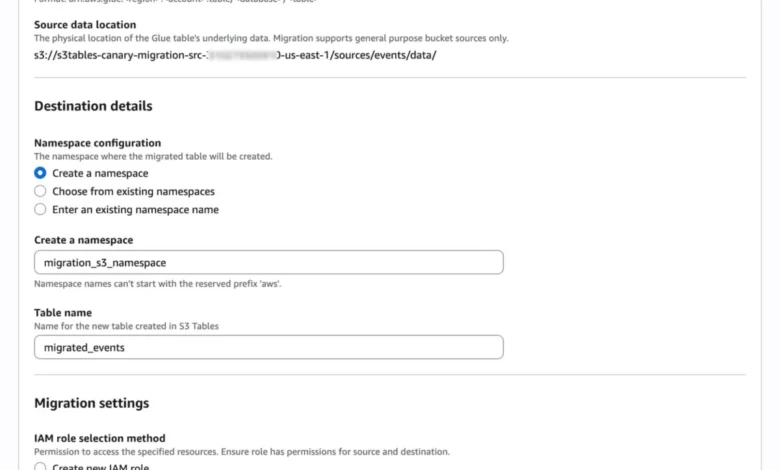
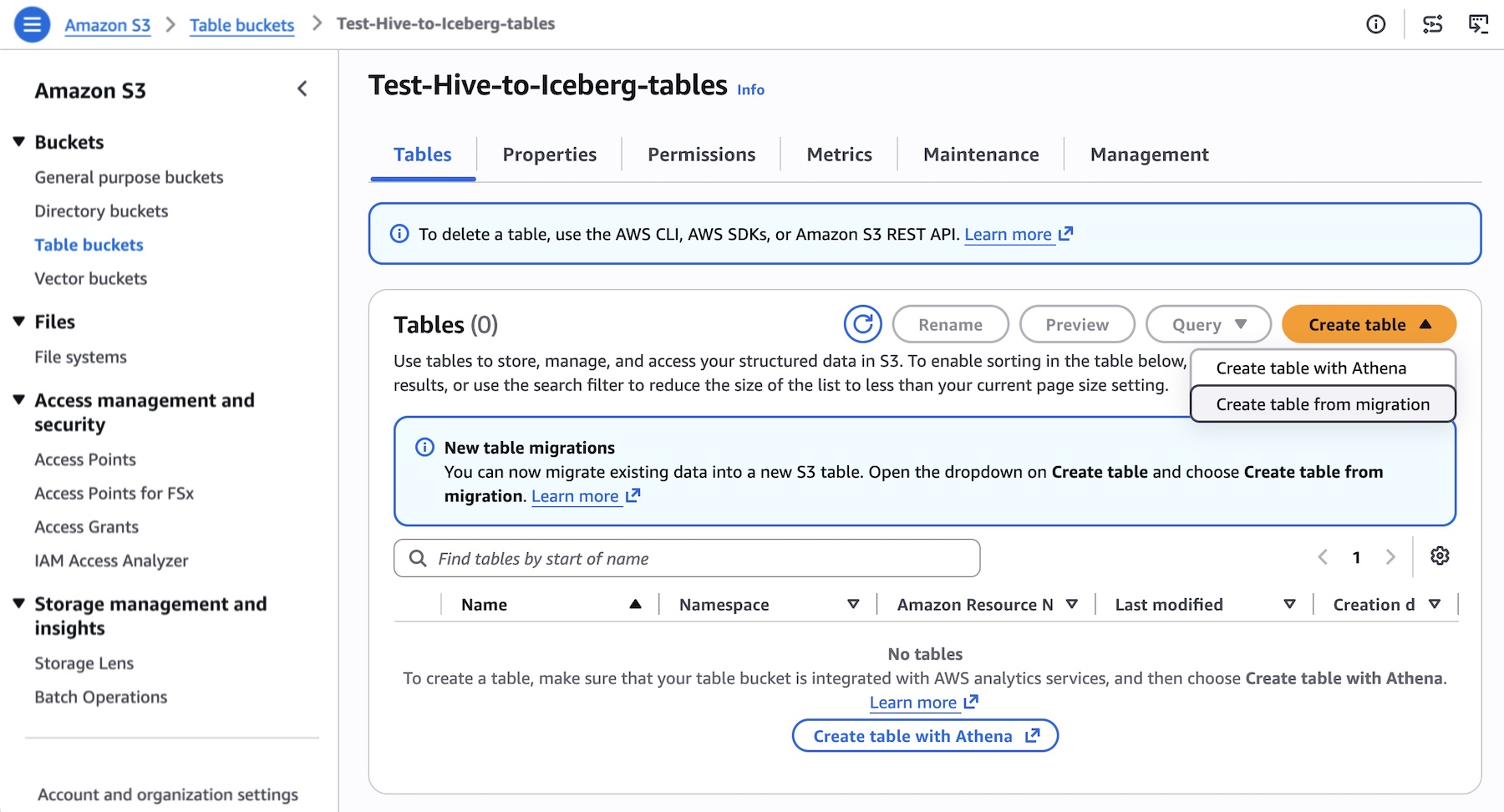
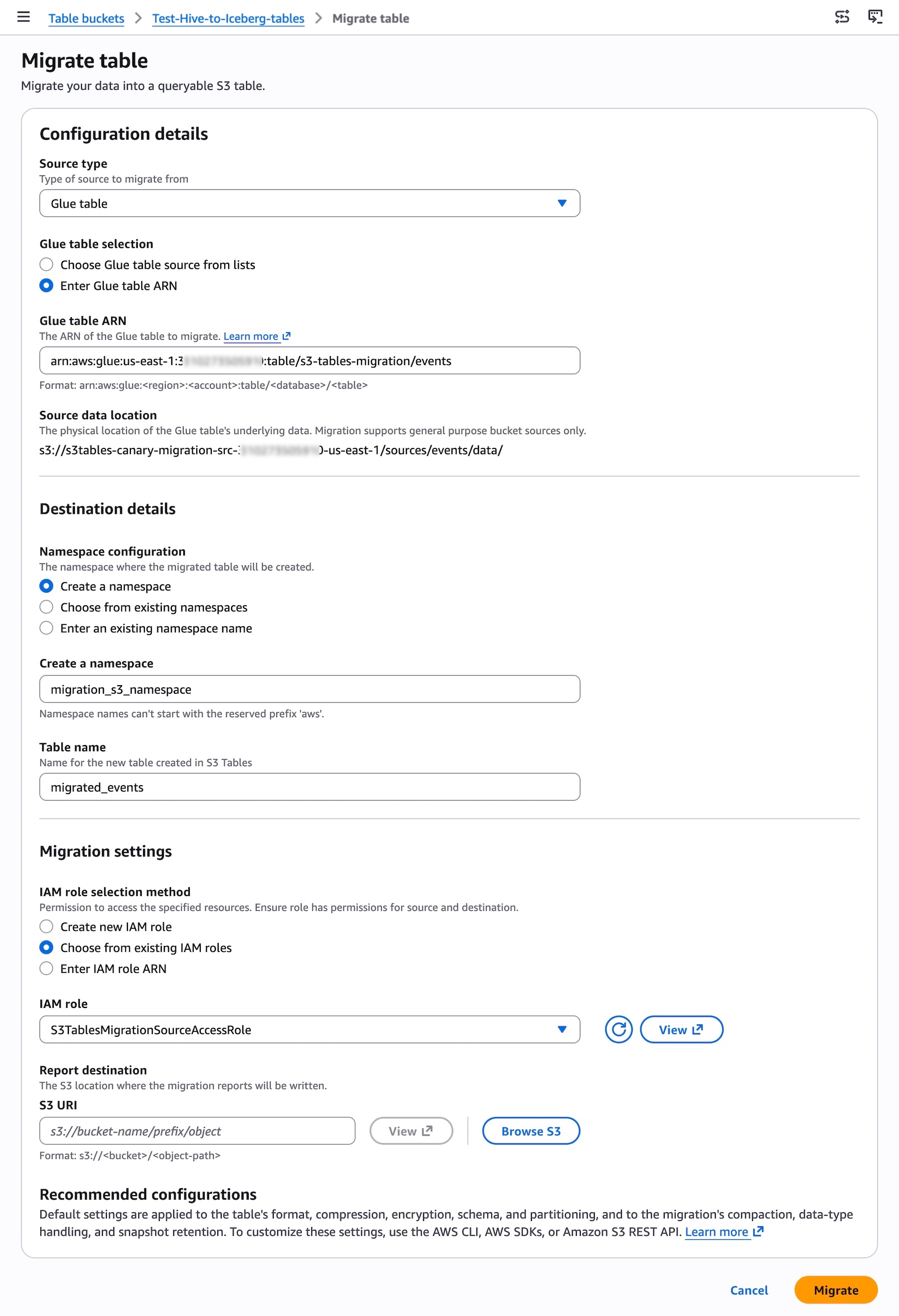
The process begins directly within the Amazon S3 console or programmatically via the AWS Command Line Interface (AWS SDKs), AWS SDKs, or developer tools such as the Agent Toolkit for AWS. Users simply select their source AWS Glue-registered Hive table stored in Parquet format, specify a destination table bucket, and initiate the migration sequence.
Before any data is actually duplicated or transformed, S3 Tables automatically inspects every source object in scope and generates a comprehensive compatibility report. This proactive validation phase identifies potential schema mismatches, incompatible data types, or orphaned files, giving data administrators complete visibility before committing to the migration path.
Once validation is complete, S3 Tables executes the heavy lifting behind the scenes. The service handles data validation, compatibility checks, complex data type conversions, file recompression using modern codecs like Zstandard (zstd), and automatic file compaction optimized for query efficiency. During the primary data copy phase, the destination table operates in a read-only state. Crucially, however, production workloads can continue writing to the source Hive table uninterrupted throughout the migration process.

To bridge the gap between ongoing source updates and the target Iceberg table, administrators can execute a continuous synchronization command—sync-table-migration—as many times as necessary. Each synchronization iteration incrementally copies only the data that has changed since the last sync. When the organization is ready to finalize the transition, a final brief cutover lasting only a few minutes is performed, during which the destination table is promoted to read-write status, minimizing operational downtime to near-zero levels.
Economic Efficiency and Cost Optimization
A critical barrier to legacy data lake modernization has always been the sheer cost of infrastructure and duplicate storage during transitions. Traditional self-managed migration strategies typically require provisioning heavy compute resources, such as EMR or Spark clusters, to run continuous translation jobs, alongside temporary storage spikes that inflate cloud expenditure.
Amazon S3 Tables addresses this economic challenge through an optimized, usage-based pricing structure. Organizations pay exclusively for the exact volume of data copied during the migration process. There are zero additional charges levied by AWS for the underlying Hive-to-Iceberg format conversion, data type mapping, or file compaction routines.
Furthermore, for datasets stored in Amazon S3 Intelligent-Tiering, source objects remain securely within their existing access tiers throughout the migration workflow. This thoughtful architectural choice prevents unexpected access-tier penalties or retrieval fees, making large-scale modernization financially viable even for resource-constrained engineering teams.
Technical Architecture and Implementation Details
At launch, the managed migration capability supports AWS Glue-registered Hive tables stored in Apache Parquet format within the same AWS account and AWS Region. The generated destination tables reside within Amazon S3 Tables, which are fully managed storage buckets purpose-built to maintain high performance and low storage overhead for Iceberg tables automatically.
Administrators maintain granular control over destination table properties, security configurations, and maintenance policies. Through JSON configuration templates passed via the AWS CLI or SDKs, engineers can define custom encryption parameters using AWS Key Management Service (KMS), establish rigorous data governance tags, configure specific Iceberg format versions (such as Version 2), and set up automated maintenance routines. These maintenance settings include bin-packing compaction targets—such as specifying a 512 MB target file size—and automated snapshot management policies to retain a specified minimum number of historical snapshots while pruning aging states.
For developer teams incorporating artificial intelligence and coding assistants into their workflows, specialized integrations are also available. The migrating-hive-tables-to-s3-tables skill within the Agent Toolkit for AWS provides step-by-step guidance and safety guardrails for AI coding agents like Kiro. Additionally, engineers can leverage the AWS MCP Server and associated plugins to query API documentation, verify regional availability, and troubleshoot migration errors directly from their preferred integrated development environments.
Initial Regional Availability and Deployment
Amazon S3 Tables managed migration is available immediately across a broad footprint of major AWS Regions. In North America, the service is active in the US East (N. Virginia, Ohio) and US West (Oregon) Regions. Across the Asia-Pacific theater, supported regions include Mumbai, Singapore, Sydney, and Tokyo. In Europe, availability spans the Frankfurt, Ireland, and Stockholm Regions.
Industry Implications and Future Outlook
The introduction of managed Hive-to-Iceberg migration marks a significant milestone in the maturation of cloud-native data architectures. By lowering the technical and financial barriers associated with table format upgrades, AWS is effectively accelerating the broader industry transition toward open, interoperable lakehouse patterns.
As organizations increasingly demand real-time analytics, machine learning integration, and vendor-agnostic query engines—such as Amazon Athena, Amazon SageMaker Unified Studio, and various third-party compute frameworks supporting the Apache Iceberg REST API—legacy data formats like Hive are rapidly becoming technical debt. With automated, API-driven tools now handling the complexities of migration, enterprises can redirect valuable engineering talent away from tedious infrastructure maintenance and toward high-value data science and business intelligence initiatives.