Amazon Web Services Expands Elastic Block Store Capabilities with Cross-Account Volume Clones and Advanced Encryption Controls


Amazon Web Services (AWS), a subsidiary of Amazon.com Inc., has officially announced a significant enhancement to its cloud storage infrastructure by introducing cross-account copy functionality for Amazon Elastic Block Store (Amazon EBS) volume clones. This new feature enables enterprise customers and developers to generate instant, point-in-time copies of their block storage volumes directly across distinct AWS accounts. By bridging the security and organizational boundaries inherent in multi-account environments, the update addresses a long-standing workflow hurdle for engineering teams that require production-grade data in isolated development, testing, and experimental sandboxes.
The announcement builds upon the initial rollout of Amazon EBS Volume Clones, which debuted the previous year to provide instant, zero-waiting-period storage duplication within a single Availability Zone. With the latest capability, organizations can leverage AWS Key Management Service (AWS KMS) to optionally re-encrypt data using target-specific keys upon arrival in the secondary account. This integration maintains stringent compliance policies while streamlining data pipelines across disparate business units and operational silos.
Core Mechanics and Technical Execution
The workflow for executing a cross-account EBS volume clone leverages the existing architecture of AWS Resource Access Manager (AWS RAM), a service designed to securely share AWS resources across multiple accounts or within a centralized AWS Organization.
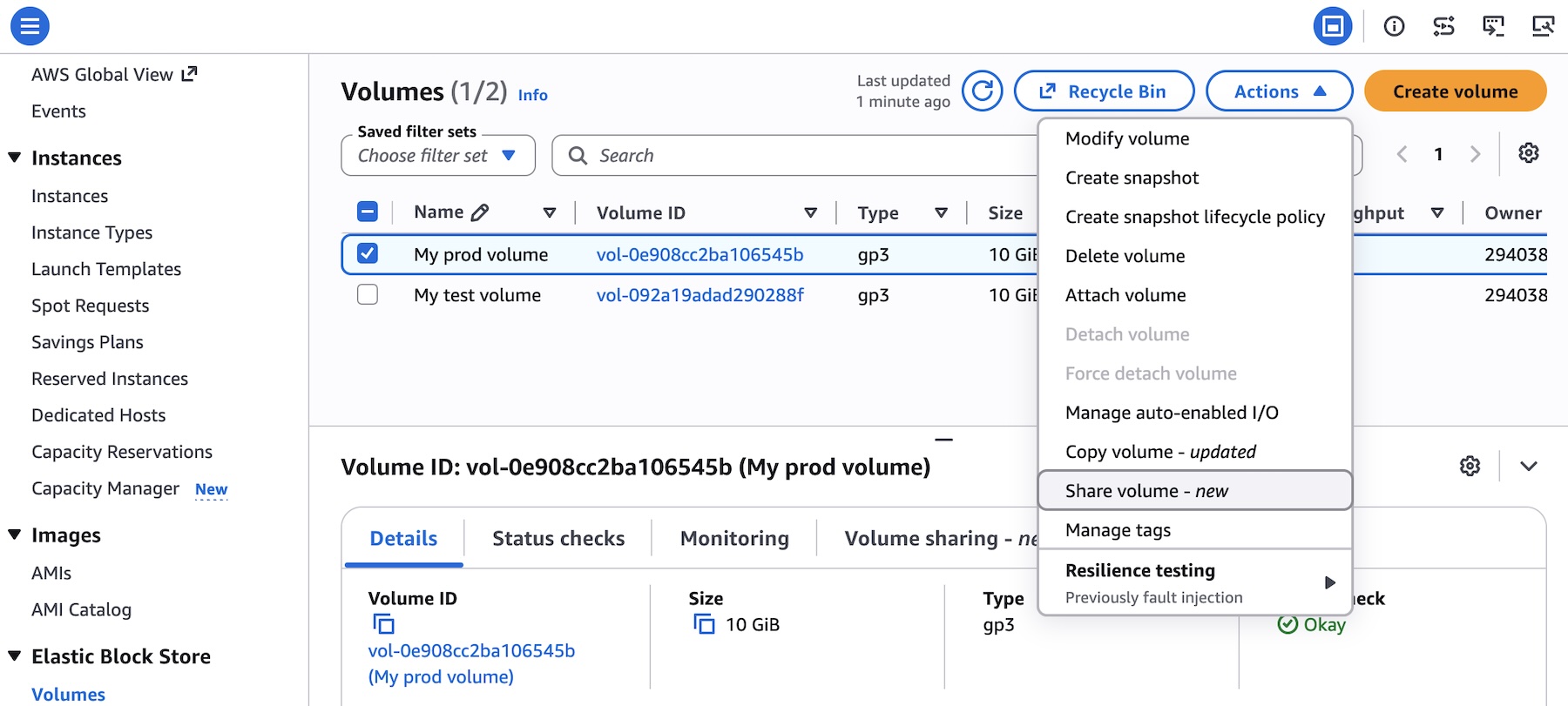
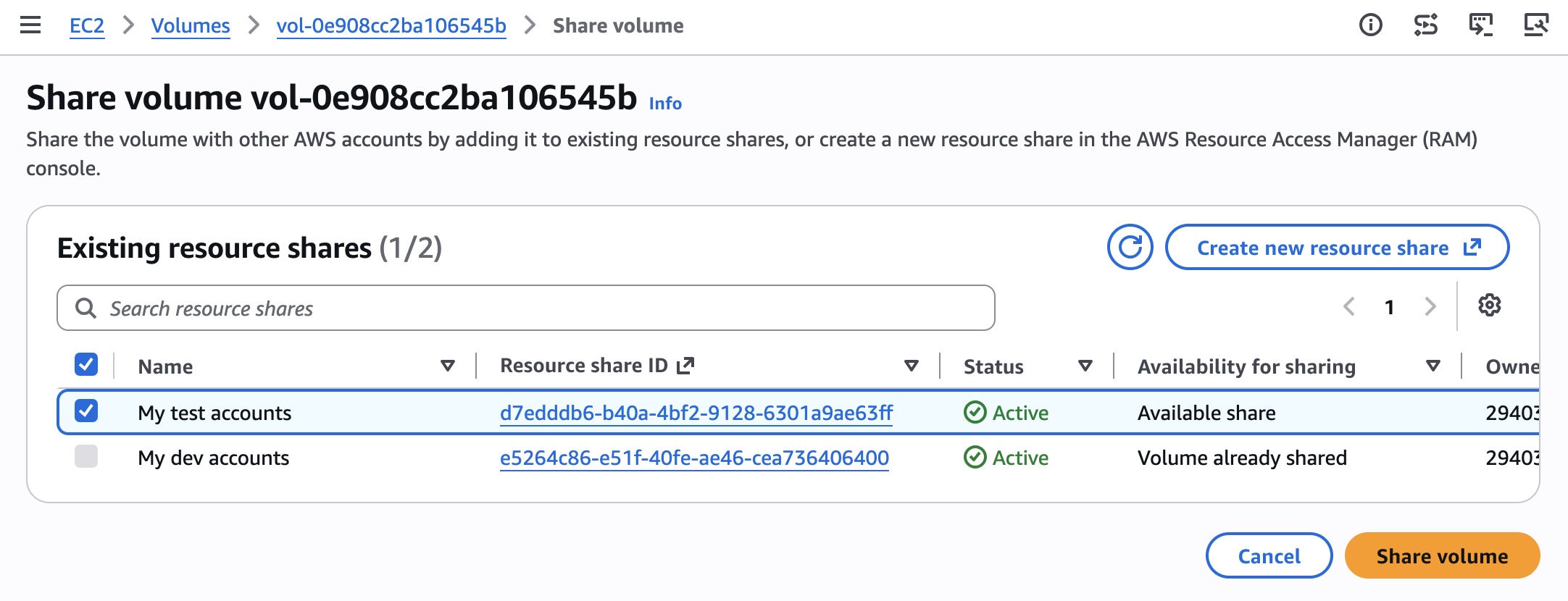
To initiate the process, the owner of the source EBS volume navigates to the Amazon EBS console, selects the specific storage asset, and triggers the "Share volume" directive. The volume can then be incorporated into existing resource shares or designated as part of a newly established resource share within the AWS RAM console. Once configured, the volume details page displays a confirmation under a dedicated "Volume sharing" tab, verifying that the cross-account permissions have been successfully propagated.
On the receiving end, an authorized administrator in the target AWS account must log into the RAM console to formally accept the resource share. Following acceptance, the shared volume becomes visible within the target account’s EBS volume management interface. The operator in the secondary account can then select "Copy volume" to instantiate an independent, fully functional clone. During this copying phase, administrators can apply a localized AWS KMS key to satisfy regulatory frameworks, data sovereignty mandates, or internal corporate security protocols.

For organizations leveraging automation and modern software development methodologies, AWS has also integrated support for these operations into developer toolsets. Engineering teams can execute and manage cross-account volume sharing and copying programmatically using the AWS MCP Server and associated plugins compatible with leading AI-driven coding environments.
Background Context and Cloud Architecture Evolution
The evolution of cloud storage management has increasingly focused on balancing rigorous administrative isolation with operational agility. In modern cloud architecture, enterprises routinely segment their workloads across multiple AWS accounts to enforce the principle of least privilege, optimize billing attribution, and contain potential security breaches. However, this multi-account posture frequently creates operational friction, particularly when engineering and data science teams require fresh, production-grade datasets to debug performance bottlenecks, validate software patches, or train machine learning models.
Historically, replicating storage across accounts involved capturing traditional snapshots, copying those snapshots across accounts, and subsequently provisioning new volumes from them. While reliable, this multi-step procedure introduced latency, consumed administrative bandwidth, and complicated snapshot lifecycle management. The introduction of instant volume clones within a single account partially alleviated this burden. By extending this architecture to support cross-account sharing via AWS RAM, AWS has effectively eliminated intermediate snapshot translation steps, offering a streamlined pathway for inter-account data propagation.
Industry analysts note that this capability aligns with the broader push toward FinOps and DevSecOps maturity in cloud computing. By allowing development teams to refresh staging environments with anonymized or production-aligned data swiftly, organizations can shorten their software release cycles while minimizing the risk of accidental data exposure in non-production tiers.
Chronology of Amazon EBS Innovations
To understand the significance of the cross-account cloning release, it is helpful to examine the developmental timeline of Amazon EBS features that have shaped modern cloud storage management:
- 2008: AWS launches Amazon Elastic Block Store, providing persistent block storage volumes for use with Amazon EC2 instances.
- 2012–2018: Introduction of foundational data protection mechanisms, including automated snapshot lifecycles, cross-Region snapshot copies, and default encryption at rest using AWS KMS.
- 2024: AWS introduces Amazon EBS Volume Clones, enabling instant, point-in-time storage duplication within the same Availability Zone without upfront data movement penalties.
- 2025 (Current Release): AWS expands the volume cloning architecture to support cross-account operations via AWS RAM, coupled with target-account re-encryption capabilities and AI-assisted programmatic tooling.
Industry Implications and Technical Analysis
The implementation of cross-account EBS volume clones carries notable implications for enterprise security architectures, data governance, and developer productivity.
From a security standpoint, the reliance on AWS RAM ensures that resource sharing remains explicit, auditable, and revocable. Administrators retain granular control over which external accounts gain visibility into specific storage blocks, preventing unauthorized access. Furthermore, the mandatory requirement for the target account to accept the resource share introduces a crucial human-in-the-loop validation step, mitigating the risk of inadvertent data exposure caused by misconfigured automated scripts.
From a financial and operational perspective, instant cloning bypasses the traditional capacity provisioning overhead associated with full data migrations. Because EBS volume clones rely on a redirect-on-write architecture under the hood, storage consumption in the source and target environments scales efficiently. Organizations no longer need to maintain bloated, permanently provisioned staging databases that mirror production capacity; instead, they can spin up ephemeral, exact-replica environments precisely when needed for testing cycles and decommission them immediately afterward.
Technical feedback gathered from early adopters emphasizes the value of the KMS re-encryption feature. In highly regulated sectors such as finance, healthcare, and government contracting, data must often be encrypted using distinct keys managed by separate organizational entities to maintain strict operational boundaries. The ability to automatically re-encrypt a cloned volume under a target-account KMS key satisfies these compliance requirements natively, sparing engineering teams from having to build bespoke decryption and re-encryption pipelines.

Availability and Future Outlook
AWS has confirmed that cross-account volume clones for Amazon EBS are generally available immediately across all global AWS Regions that currently support standard Amazon EBS Volume Clones. Organizations wishing to evaluate the capability can access the feature directly through the Amazon EC2 and Amazon EBS consoles, or via standard AWS SDKs and command-line interfaces.
As cloud environments continue to scale in complexity, industry observers anticipate that AWS will continue refining inter-account governance tools, potentially integrating deeper automation rules and policy-driven data lifecycles to further simplify multi-account data management. Enterprise users are encouraged to consult the official Amazon EBS User Guide for comprehensive technical documentation, API specifications, and best practices regarding resource share configurations. Feedback and technical inquiries can be channeled through the AWS re:Post community dedicated to Amazon Elastic Block Store or via standard enterprise support pathways.