Bing AI Guide Your Comprehensive Resource
Bing AI Guide: This comprehensive guide dives deep into the capabilities of Microsoft’s Bing AI, offering a detailed exploration of its features, functionalities, and practical applications. We’ll cover everything from setting up your account to leveraging advanced search techniques and understanding its future potential. Whether you’re a seasoned tech enthusiast or just starting to explore AI-powered search, this guide is designed to equip you with the knowledge and skills to effectively utilize Bing AI.
From its initial setup and core functionalities to advanced search techniques and real-world applications, this guide provides a step-by-step approach. We’ll also examine its strengths, weaknesses, and compare it to other prominent AI assistants like Google AI and Bard, providing valuable context for informed decision-making. Expect a detailed breakdown of the various interfaces, troubleshooting tips, and a look into the future of Bing AI’s evolution.
Introduction to Bing AI Guide
Bing AI is a powerful large language model developed by Microsoft. It leverages cutting-edge technology to provide a wide range of capabilities, from answering questions and generating creative text to summarizing information and performing complex calculations. This guide provides a comprehensive overview of Bing AI, explaining its features, benefits, and how it compares to other leading AI assistants.
It’s designed for users seeking to understand and utilize Bing AI effectively.This guide is intended for a broad audience, from those new to AI technology to experienced users looking to explore Bing AI’s advanced functionalities. The guide aims to demystify Bing AI, making its capabilities accessible and understandable for everyone. Whether you’re a student, a professional, or simply curious about AI, this guide will equip you with the knowledge you need to navigate and make the most of this powerful tool.
Bing AI is a pretty cool tool for getting insights, but if you’re looking to expand your business internationally, a solid guide on navigating the complexities of international Amazon sales can be crucial. For example, understanding the nuances of different marketplaces like the guide international amazon can help you avoid common pitfalls and maximize your reach. Ultimately, whether you’re a seasoned entrepreneur or just starting out, Bing AI can still be a powerful resource to support your ventures.
Key Features and Benefits of Bing AI
Bing AI offers a diverse range of functionalities. It can perform tasks such as answering questions, providing summaries of text, generating different creative content, translating languages, and performing calculations. Its versatility and ability to learn and adapt make it a valuable tool for various purposes.
- Question Answering: Bing AI excels at providing comprehensive and accurate answers to a wide range of questions, from simple queries to complex inquiries. It leverages its vast knowledge base to offer detailed and well-researched responses.
- Content Generation: Bing AI can generate various types of content, including articles, stories, poems, and scripts. This feature is beneficial for writers, students, and anyone seeking creative inspiration or assistance.
- Summarization: Bing AI can condense lengthy texts into concise summaries, making it an invaluable tool for quick information retrieval and analysis.
- Translation: Bing AI offers accurate and fluent translation between numerous languages. This feature is particularly helpful for communication across different cultures and languages.
- Calculation and Problem Solving: Bing AI can perform complex calculations and solve problems in various fields, including mathematics, science, and engineering. It can handle both simple arithmetic and intricate formulas, making it a powerful tool for numerical analysis.
Comparison with Other AI Assistants
This section provides a comparative overview of Bing AI against other prominent AI assistants, highlighting their respective strengths and weaknesses.
| Feature | Bing AI | Google AI (e.g., Bard) | Other AI Assistants |
|---|---|---|---|
| Comprehensive Knowledge Base | Bing AI draws on a vast and updated knowledge base, enabling it to provide accurate and comprehensive responses. | Google AI possesses a vast knowledge base, often updated, which facilitates comprehensive answers. | Other assistants typically have a significant knowledge base but may lack the depth or breadth of Bing AI and Google AI. |
| Natural Language Processing | Bing AI excels at understanding and responding to natural language queries, allowing for a more conversational and user-friendly interaction. | Google AI demonstrates strong natural language processing abilities, providing user-friendly interaction. | Other AI assistants vary in their capabilities, some potentially lacking the sophistication of Bing AI and Google AI. |
| Creative Content Generation | Bing AI can generate various creative content formats, such as poems, stories, and scripts. | Google AI can also generate creative content, but its specific strengths may vary. | Other assistants’ creative content generation capabilities may differ, and some may lack the sophistication of Bing AI and Google AI. |
| Availability | Bing AI is readily accessible through the Bing search engine. | Google AI is integrated into Google Search and other Google products. | Accessibility varies significantly depending on the specific AI assistant. |
Guide Structure and Organization
This guide is structured into logical sections to enhance comprehension and usability. Each section focuses on a specific aspect of Bing AI, from its core functionalities to comparisons with other AI assistants.
- Introduction: Provides a general overview of Bing AI and its purpose.
- Features and Benefits: Explores the key functionalities and advantages of Bing AI.
- Comparison with Other AI Assistants: Presents a comparative analysis of Bing AI against leading AI assistants.
- Practical Applications: Demonstrates how Bing AI can be used in real-world scenarios.
- Troubleshooting and FAQs: Addresses potential issues and provides answers to frequently asked questions.
Getting Started with Bing AI
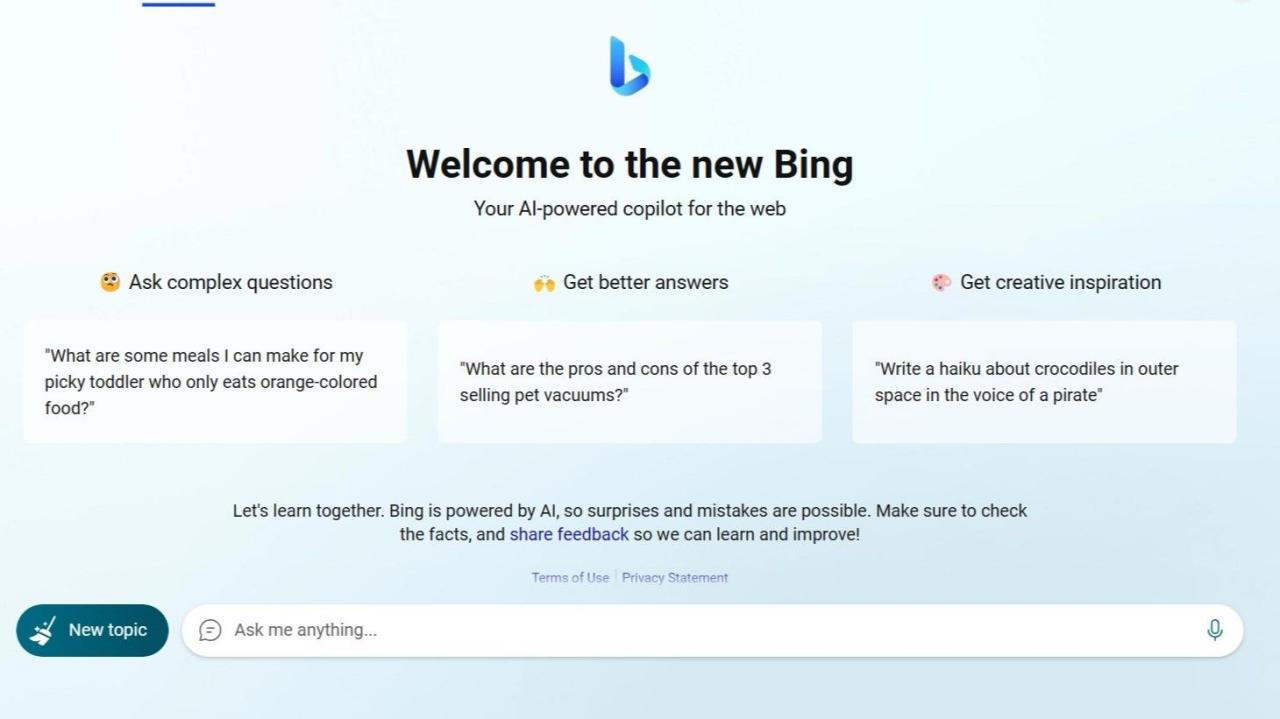
Embarking on your Bing AI journey is straightforward and rewarding. This section details the steps to set up your account, navigate the interface, and troubleshoot any initial hurdles. Familiarizing yourself with the various interfaces will empower you to maximize Bing AI’s potential.Setting up a Bing AI account is a simple process. The initial setup involves creating an account with Microsoft, ensuring your privacy settings are aligned with your preferences, and selecting a suitable interface.
By following the steps Artikeld below, you’ll be well-equipped to begin exploring the capabilities of Bing AI.
Bing AI is a powerful tool, but knowing how to use it effectively is key. One area where this comes in handy is crafting compelling online ads. Learning to use Bing AI for ad copy can significantly improve your results. Consider exploring how Bing AI can be used to target specific audiences with online ads and increase engagement, which is crucial for any successful online marketing strategy.
Ultimately, mastering Bing AI’s potential unlocks more opportunities for your online ventures.
Account Setup and Initial Configuration
To utilize Bing AI, you’ll need a Microsoft account. If you already have one, simply sign in. Otherwise, create a new account. The account setup process is standard for most Microsoft services. Once logged in, you can personalize your settings and choose from various interface options to suit your preferences.
Initial Setup Process
- Navigate to the Bing AI website. Click the “Sign in” button.
- If you don’t have a Microsoft account, click “Create account” to initiate the registration process.
- Enter your desired username, password, and other requested information.
- Review and confirm your account details. Complete the verification process if necessary.
- Upon successful account creation, you’ll be redirected to the Bing AI interface. Explore the various features and options to understand the functionalities.
Configuration Options
- Interface Selection: Bing AI offers different interface options to cater to diverse user needs. Each interface may emphasize specific functionalities or present information in a unique format.
- Privacy Settings: Review and adjust privacy settings to ensure your data is handled in accordance with your comfort level. These settings often dictate how your interactions with Bing AI are stored and used. Ensure you understand and agree with these settings before proceeding.
- Personalization Options: Tailor the experience to your liking. Personalization features might include customization of display themes, language preferences, and other aesthetic aspects.
Common Issues and Troubleshooting
- Sign-in Issues: If you encounter issues with signing in, double-check your username and password. Ensure your internet connection is stable. Contact Microsoft support if the problem persists.
- Interface Problems: If you experience difficulties with the interface, review the instructions provided on the Bing AI website or explore the help documentation. Clear steps for navigating and using each interface variant are usually provided.
- Account Security: Protect your Microsoft account by maintaining strong passwords and enabling two-factor authentication where possible. Be wary of phishing attempts.
Step-by-Step Guide for New Users
- Create or log into your Microsoft account.
- Access the Bing AI website.
- Familiarize yourself with the interface, exploring different options and features.
- Utilize the help resources available on the website to understand the available features.
- Experiment with various prompts and commands to understand Bing AI’s functionalities.
Different Bing AI Interfaces
| Interface | Description |
|---|---|
| Conversational Interface | Ideal for natural language interactions, allowing you to ask questions and receive detailed responses in a conversational manner. |
| Research Interface | Designed for in-depth research and information retrieval. This interface typically displays results in a structured format, suitable for comprehensive study. |
| Creative Interface | Supports generating creative content such as poems, stories, and scripts. |
Core Features and Capabilities
Bing AI’s core strength lies in its ability to seamlessly integrate search with advanced conversational AI. It’s not just about finding information; it’s about understanding context and providing relevant answers in a natural, human-like way. This allows users to explore information more deeply and efficiently.This comprehensive approach allows for more nuanced interactions with the search engine. Instead of simply presenting a list of links, Bing AI strives to deliver a cohesive and organized summary of the most pertinent information, often including relevant supporting details and context.
Bing AI’s Search Functionalities
Bing AI’s search functionality goes beyond traditional searches. It leverages natural language processing (NLP) to understand the intent behind user queries, resulting in more accurate and comprehensive results. This means you can ask complex questions in everyday language, and Bing AI will strive to provide the most relevant and accurate response.
Advanced Search Methods
Bing AI offers various search methods tailored to different query types. This allows users to explore data in different ways, leading to more specific and comprehensive results.
- Using specific s: Precisely defined s can help narrow the search scope, focusing the results on specific aspects of the query. For example, searching for “best Italian restaurants in New York City near Central Park” will yield results tailored to those specific criteria.
- Using advanced operators: Operators like “site:” (e.g., “site:nytimes.com climate change”) allow you to specify a website or domain, providing more targeted results. Similarly, using quotation marks (” “) around phrases helps find results containing those exact words. “Best pizza in Brooklyn” will return results containing that exact phrase, rather than results about “best pizza” and “Brooklyn” separately.
- Using conversational queries: Asking complex questions in a natural language format, like “What are the environmental impacts of fracking?” enables Bing AI to understand the user’s intent and provide a more nuanced response.
Strengths and Weaknesses
Bing AI excels in understanding the context of queries and providing comprehensive answers. It leverages a vast dataset of information, enabling it to synthesize information from various sources.
- Strengths: Its ability to understand nuanced queries, provide summaries, and integrate information from different sources is a significant strength. Its conversational interface also allows for a more engaging and interactive user experience. For instance, you can ask for comparisons between products, or for a summary of a complex historical event.
- Weaknesses: While Bing AI generally provides accurate responses, it may sometimes struggle with queries that are highly specific or contain highly nuanced terminology. Additionally, like other AI models, it can sometimes produce inaccurate or biased information, so users should always critically evaluate the responses. This is particularly important when relying on the AI for sensitive or important decisions.
Core Features and Functionalities
Bing AI integrates several key features, offering a comprehensive and interactive experience.
Bing AI’s guide is a great starting point for exploring AI’s potential, but to really maximize its effectiveness, understanding how to track your goals using tools like tracking goals tag manager is key. Knowing which metrics are truly important and how to measure them within your digital campaigns will ultimately refine your use of Bing AI to achieve your desired outcomes.
Ultimately, this deeper understanding will significantly boost the impact of your Bing AI interactions.
| Core Feature | Functionality |
|---|---|
| Natural Language Processing (NLP) | Understanding the intent behind user queries, enabling more accurate and relevant results. |
| Information Synthesis | Combining information from various sources to provide a more comprehensive understanding of a topic. |
| Conversational Interface | Allowing users to interact with the AI in a natural and engaging way, enabling more complex and nuanced queries. |
| Advanced Search Operators | Providing tools like “site:” and quotation marks to refine search results, focusing on specific aspects of a query. |
Advanced Usage and Techniques
Unlocking the full potential of Bing AI requires more than just basic queries. This section delves into advanced search techniques, query refinement, research strategies, and the powerful features that transform Bing AI from a helpful tool to a research powerhouse. Mastering these techniques empowers you to extract precise information and achieve greater efficiency in your research endeavors.Advanced search techniques allow you to hone your inquiries, significantly improving the accuracy and relevance of the results.
By understanding and employing these methods, you can navigate the vast ocean of information and retrieve the specific data you need.
Advanced Search Techniques
Refining search queries is crucial for extracting the most relevant information. By employing specific operators and modifiers, you can filter results and focus on particular aspects of your query. This precision ensures that the output is tailored to your specific needs, minimizing irrelevant data and maximizing the usefulness of the results.
- Using quotation marks (“…”): Enclosing s in quotation marks forces Bing AI to search for the exact phrase, ensuring that results precisely match the words in the specified order. This is particularly useful when searching for specific titles, quotes, or phrases. For example, searching “best Italian restaurants in Rome” will return results focused on restaurants matching that exact phrase, rather than results containing individual words.
- Using the minus sign (-): The minus sign excludes specific words or phrases from the search results. This is beneficial when you want to narrow down results by excluding unwanted topics. For example, searching “best coffee shops -expensive” will filter out coffee shops with high price tags, focusing on those that are more affordable.
- Using the asterisk (*): The asterisk acts as a wildcard, substituting for any missing words or characters. This is helpful when you are unsure of the exact spelling or remember only part of a phrase. For example, searching “data science
-analysis” will find results related to data science analysis, whether the phrase is “data science advanced analysis” or “data science business analysis”. - Using Boolean operators (AND, OR, NOT): Boolean operators refine searches by specifying relationships between s. “AND” searches for results containing both s; “OR” searches for results containing either ; and “NOT” excludes results containing a specific . For example, searching “best laptops AND under $1000” will return laptops that meet both criteria. Searching “Italian food OR French food” will return results for either cuisine.
Query Refinement Strategies
Formulating precise queries is fundamental to obtaining accurate and targeted results. Strategies for refining queries involve modifying search terms and employing advanced operators to refine the search process and improve accuracy.
- Specificity and clarity: Using precise and specific s in your queries leads to more focused results. Instead of “best hotels,” try “best luxury hotels in Paris near the Eiffel Tower.” This level of detail yields more relevant results.
- Breaking down complex topics: Complex topics can be broken down into smaller, more manageable s. This allows for a more structured search approach and a better understanding of the topic’s components. For example, instead of searching for “the history of the internet,” try “early internet development” followed by “evolution of the internet protocols” to better understand the history.
- Using synonyms and related terms: Including synonyms and related terms broadens the search scope, ensuring that you don’t miss relevant results. This ensures comprehensive results that capture different facets of the topic. Instead of “marketing strategies,” try “marketing techniques OR promotional strategies” to ensure all relevant topics are covered.
Leveraging Bing AI for Research
Bing AI can be a powerful research tool, especially when combined with advanced search techniques. It’s not just a search engine, but a research assistant that allows you to gather, organize, and analyze information efficiently.
- Combining sources: Bing AI can aggregate information from various sources, allowing you to cross-reference and compare different perspectives. This helps you gain a more comprehensive understanding of the subject matter.
- Synthesizing information: Bing AI can summarize and synthesize information from multiple sources, creating a concise overview of a topic. This is invaluable for researchers needing a quick overview of a subject.
- Tracking evolving information: Bing AI can help you stay updated on current trends and developments in a specific field. Its ability to track information over time is particularly valuable for research in rapidly changing fields.
Saving and Organizing Search Results
Saving and organizing search results is vital for managing and referencing information efficiently. This process ensures that you have quick access to important findings and facilitate the organization of your research.
- Saving results to notebooks: Bing AI allows users to save results to their personal notebooks. This facilitates the organization and retrieval of information later.
- Creating folders and subfolders: Organize results by creating folders and subfolders. This allows you to group related information, enabling easier retrieval.
- Using tags and labels: Tags and labels allow you to categorize results by , topic, or other relevant criteria. This provides an effective method for organizing your research material.
Practical Applications and Examples
Bing AI’s capabilities extend far beyond simple information retrieval. Its ability to understand context, generate creative text, and synthesize information makes it a valuable tool in a variety of fields. This section explores real-world use cases and examples of how Bing AI can enhance productivity and problem-solving across different contexts.Bing AI’s strength lies in its versatility. From streamlining research to sparking creative ideas, its applications are diverse and impactful.
This guide delves into practical examples, showcasing how Bing AI can be leveraged to achieve tangible results in various scenarios.
Real-World Use Cases, Bing ai guide
Bing AI can be a powerful asset for diverse professionals and individuals. Its ability to synthesize information and generate creative text allows for efficiency gains and innovative solutions.
- Business Strategy Development: Bing AI can analyze market trends, competitor data, and customer feedback to help businesses develop effective strategies. For instance, a marketing team could use Bing AI to research emerging trends in social media and identify potential target audiences. This analysis can inform strategic decisions and improve marketing ROI.
- Content Creation: Bing AI can generate various types of content, from blog posts and articles to scripts and poems. A writer could utilize Bing AI to brainstorm ideas, generate Artikels, or even complete drafts of articles. This can free up time and resources for more focused creative work.
- Customer Service Enhancement: Bing AI can automate routine customer service tasks, providing instant answers to common queries. This allows human agents to focus on more complex issues, leading to improved customer satisfaction and reduced response times. For example, a customer service team could use Bing AI to answer frequently asked questions about product returns or shipping information.
- Research and Analysis: Bing AI can synthesize information from diverse sources, streamlining the research process. Students and researchers can use Bing AI to quickly gather information from various scholarly articles, news reports, and websites. This can be particularly helpful for creating comprehensive reports or research papers.
Creative Applications
Bing AI can be a valuable tool for creative tasks. Its ability to generate text and explore various writing styles makes it a powerful partner for brainstorming and ideation.
- Brainstorming Ideas: Bing AI can generate diverse ideas and perspectives. For example, an artist could use Bing AI to generate a list of unique themes or concepts for a new painting. This can stimulate creative thinking and unlock fresh perspectives.
- Writing Different Genres: Bing AI can create various types of text, including poems, scripts, stories, and articles. A writer could use Bing AI to experiment with different writing styles and explore new narrative structures. For instance, a novelist could prompt Bing AI to create different plotlines and character arcs for a new novel.
- Generating Unique Content: Bing AI can create text formats that are difficult for humans to reproduce, such as creative scripts, code, and music. A musician could use Bing AI to generate new melodies and harmonies, while a programmer could use it to generate code snippets or explore new algorithms.
Use Case Examples
The table below illustrates diverse use cases and corresponding applications of Bing AI.
| Use Case | Application |
|---|---|
| Developing a marketing strategy for a new product | Analyzing market trends, identifying target audiences, and generating marketing materials. |
| Creating a blog post about a specific topic | Generating Artikels, researching relevant information, and drafting initial content. |
| Responding to customer inquiries about product specifications | Providing instant answers to common questions and routing complex inquiries to human agents. |
| Conducting research for a university paper | Synthesizing information from various sources, identifying key arguments, and generating summaries. |
Troubleshooting and Support
Navigating new AI tools can sometimes lead to unexpected challenges. This section details common issues users might encounter with Bing AI and provides solutions, ensuring a smoother experience. Understanding potential problems and their resolutions will help you get the most out of Bing AI’s capabilities.Effective troubleshooting is crucial for maximizing the potential of any AI tool. By understanding the common pitfalls and their remedies, users can overcome obstacles and fully leverage Bing AI’s features.
Common Bing AI Issues
Users may encounter various issues while interacting with Bing AI. These issues can stem from a multitude of factors, including input format, expected output, or unexpected responses. Careful analysis of the problem and adherence to best practices can often resolve these issues effectively.
- Incorrect or Unclear Prompts: Bing AI relies on clear and specific prompts. Ambiguous or poorly structured prompts can lead to confusing or irrelevant responses. Providing context and specifying desired output format can resolve this issue.
- Unresponsive or Slow Responses: Occasional slowdowns or complete unresponsiveness can occur due to high server load or complex queries. Waiting a reasonable amount of time or simplifying the query can often resolve this issue. If the problem persists, consider contacting support.
- Inaccurate or Irrelevant Results: Bing AI, like any AI system, may occasionally produce inaccurate or irrelevant information. This can be due to the complexity of the question or the quality of the available data. Rephrasing the query or providing additional context can often lead to more accurate and relevant results.
- Unexpected Errors or Errors in Output Format: Errors in the output format, such as missing information or an incorrect format, can sometimes occur. Providing more details in the prompt or checking the output format can help resolve these issues. Rephrasing the query or adjusting parameters may also yield more desirable results.
Troubleshooting Steps
Effective troubleshooting involves systematically identifying the root cause of the problem. A methodical approach, coupled with clear communication, significantly improves the resolution time.
- Check the Prompt: Carefully review the prompt for clarity and accuracy. Ensure the prompt is specific and provides sufficient context. Verify that the input is formatted correctly and aligns with Bing AI’s expectations.
- Rephrase the Query: If the initial query doesn’t yield the desired results, try rephrasing the query in a different way. This may help the AI understand the intent more accurately. Be specific and use s effectively.
- Provide Additional Context: Sometimes, providing additional context to the query can significantly improve the accuracy of the response. Offer details about the desired output format or any specific requirements.
- Check Internet Connectivity: Ensure a stable internet connection. Intermittent or poor internet connectivity can lead to issues with data retrieval or processing.
- Contact Support: If the problem persists after trying the above steps, contact Bing AI support for further assistance. Provide detailed information about the issue, including the prompt, the expected output, and any error messages.
Support Resources and Contact Information
Various support resources are available to assist users with any issues encountered while using Bing AI. These resources provide detailed information and guidance on common problems.
- Bing AI Help Center: The Bing AI Help Center offers a comprehensive collection of articles and FAQs covering common issues and troubleshooting steps.
- Bing AI Community Forums: Engage with other Bing AI users in the community forums to share experiences, ask questions, and receive support from the community.
- Bing AI Support Email: For more complex issues, contact Bing AI support through the designated email address.
Common Errors and Solutions
This table Artikels common errors encountered with Bing AI and their corresponding solutions.
| Error | Solution |
|---|---|
| Incorrect Prompt Format | Revise the prompt to be more specific and clearly define the desired output. |
| Unresponsive Response | Wait for a reasonable amount of time. If the problem persists, try simplifying the query. |
| Inaccurate Results | Rephrase the query, provide additional context, or try alternative s. |
| Unexpected Output Format | Specify the desired output format in the prompt. |
Future of Bing AI
Bing AI’s journey is just beginning. With its current capabilities, it’s poised to revolutionize how we interact with information and technology. The future promises even more sophisticated and integrated AI features, impacting everything from search to creative tasks.The evolution of Bing AI will be marked by increasingly sophisticated natural language processing, enabling it to understand and respond to complex queries with greater nuance and precision.
This advancement will lead to more accurate and comprehensive search results, tailored to individual user needs and preferences.
Potential Future Developments
Bing AI’s future development will likely encompass several key areas. Enhanced personalization will adapt to individual user behavior, refining search results and recommendations over time. Integration with other Microsoft products, like Office 365, will create a seamless workflow, allowing users to leverage AI-powered insights within their existing tools. The ability to perform more complex tasks, like generating creative content, will also be a significant development.
Evolving Capabilities
Bing AI’s capabilities are expanding beyond basic search. Future versions will likely feature improved summarization, allowing users to quickly extract key information from lengthy documents or articles. Real-time data integration will enable access to current events and information, ensuring search results are always up-to-date. Enhanced multilingual support will broaden the reach of Bing AI, making it accessible to a global audience.
Furthermore, advancements in image and video understanding will transform how users interact with visual data.
Predictions About the Future of AI-Powered Search
The future of AI-powered search will be characterized by seamless integration with various platforms and devices. We can expect to see AI-powered search assistants embedded in smart speakers, wearables, and even vehicles. AI will personalize search results beyond simple preferences, potentially anticipating user needs before they’re even articulated. Examples include proactive suggestions for relevant information based on user context or past interactions.
Emerging Trends in AI
The field of AI is experiencing a period of rapid advancement. One key trend is the increasing use of large language models, which are capable of generating human-quality text. Another significant trend is the growing importance of ethical considerations in AI development, including issues of bias and fairness in algorithms. Furthermore, explainable AI (XAI) is gaining prominence, aiming to make AI decision-making processes more transparent and understandable.
Comparison of Future Bing AI with Other AI Search Engines
| Feature | Bing AI | Google AI | Other AI Search Engines |
|---|---|---|---|
| Personalization | Highly personalized, anticipates user needs. | Personalized based on search history. | Varying degrees of personalization. |
| Real-time Data Integration | Potential for real-time updates from various sources. | Real-time information integration, but with varying levels of accuracy. | Limited real-time data integration. |
| Multilingual Support | Extensive multilingual support, facilitating global accessibility. | Strong multilingual support, but with potential limitations. | Varying levels of support depending on the engine. |
| Creative Content Generation | Advanced creative content generation capabilities. | Limited creative content generation abilities. | Limited or emerging capabilities. |
This table highlights potential distinctions in the future development of Bing AI compared to other prominent AI search engines. The table emphasizes areas where Bing AI could potentially excel, such as personalization and real-time data integration. Future capabilities may depend on specific developments and investments.
Closure: Bing Ai Guide
In conclusion, this Bing AI guide has provided a thorough exploration of Microsoft’s innovative AI-powered search engine. We’ve covered its diverse features, practical applications, and future prospects, enabling readers to confidently navigate the world of AI-driven search. Whether you’re seeking a powerful research tool, a creative brainstorming partner, or a problem-solving assistant, Bing AI is a valuable resource.
The guide’s comprehensive approach, coupled with practical examples and troubleshooting tips, empowers you to maximize the potential of this evolving technology.